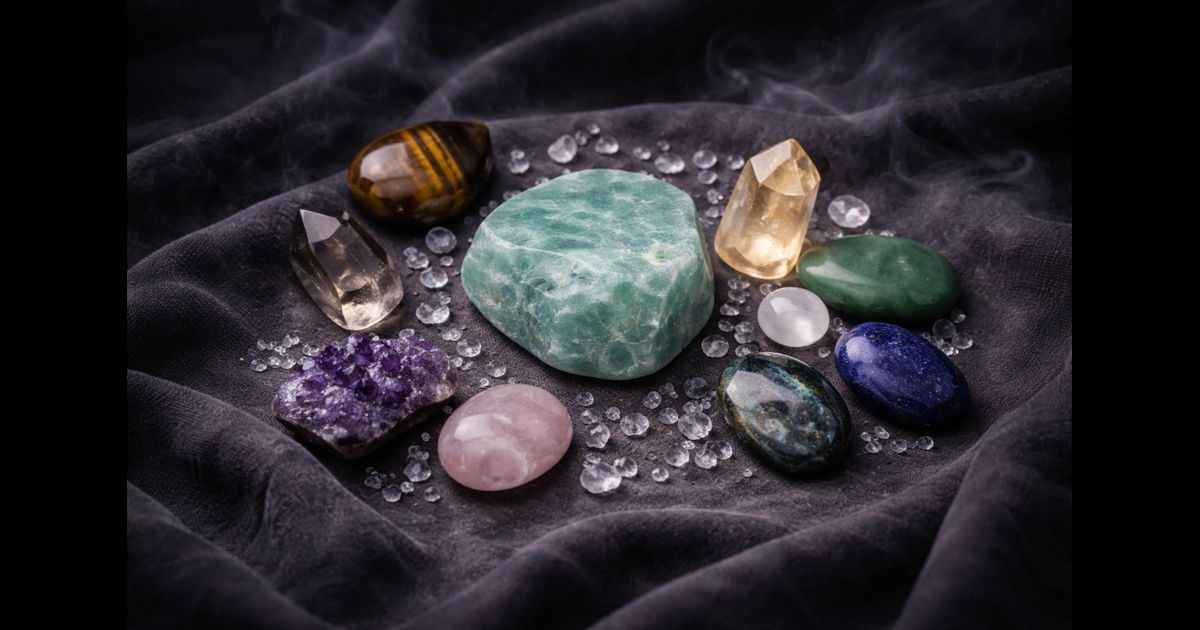
Combining crystals can multiply their effects — but some pairings create conflicting energies. Here is what you need to know.
Just as certain foods complement each other and others clash, crystals have energetic profiles that either harmonise or conflict. Knowing which combinations are powerful — and which to avoid — lets you work with crystals far more intentionally.
Amethyst + Rose Quartz: A deeply healing pairing for emotional work. Amethyst brings clarity and calm; rose quartz brings compassion and love.
Black Tourmaline + Selenite: The ultimate protection and purification duo. Tourmaline absorbs and repels negative energy; selenite cleanses and fills the space with high-vibration light.
Citrine + Pyrite + Green Aventurine: The abundance triad. Each amplifies a different aspect of prosperity — citrine the mindset, pyrite the willpower, aventurine the luck.
Clear Quartz + Any Crystal: Clear quartz amplifies the energy of any stone it is paired with. When in doubt, add clear quartz to any combination.
Moldavite + Other High-Vibration Stones: Can be overwhelming for sensitive people. Start with one at a time.
Carnelian + Blue Lace Agate: Fire and water in energetic terms. They tend to cancel each other out rather than complement.
Too Many Stones at Once: Using more than 3–4 crystals simultaneously can create noise rather than harmony. Less is more.
Golden rule: if a combination feels right in your body — it is. Trust your intuition above any guideline, including this one.
Most combination advice is presented as a list to memorise, which makes it harder than it is. Two principles cover nearly all of it.
The first is reinforcement: stones associated with the same chakra or the same purpose amplify each other. Rose quartz with rhodonite for the heart, lapis with sodalite for the throat, amethyst with selenite for the crown. Predictable and low-risk.
The second is counterweight: pairing something activating with something steadying. Moldavite with black tourmaline, carnelian with hematite, malachite with obsidian. This is the more useful principle, because the stones people find difficult are almost always the ones that need a floor under them.
Fewer than most collections suggest. Two is the standard working pair. Three is manageable when one of them is a grounding stone. Beyond that, most people cannot tell what is contributing what, and the practice becomes decorative.
The argument for restraint is practical rather than energetic: if you carry five stones and something shifts, you have learned nothing about which one to keep.
If a single rule is worth remembering, it is this one. Any stone described as high-vibration, intense or transformational — moldavite, malachite, moissanite, phenacite, labradorite at the milder end — is traditionally paired with something heavy. Black tourmaline, hematite, obsidian and smoky quartz are the usual choices.
The reasoning in the tradition is about balance. The practical version is that people who find a stone overwhelming usually keep working with it if there is something steadying in the other pocket, and abandon it entirely if there is not.
Pairs kept together need to be compatible physically as well as energetically, and this is where good combinations go wrong. Hardness is the issue: quartz at 7 will scratch selenite at 2, fluorite at 4, malachite at 4 and rhodochrosite at 4 if they share a pouch. Moldavite at 5.5 scuffs against almost anything harder.
Keep soft stones in separate compartments or wrapped individually. A combination is not much use if one half of it arrives scratched.
Two is the standard working pair, three if one is a grounding stone. Beyond that most people cannot tell what is contributing what, and the practice becomes decorative.
The usual caution is against pairing several intense stones — moldavite with malachite, for instance. The traditional fix is not avoidance but grounding: add black tourmaline, hematite or obsidian.
Two principles cover most of it. Stones sharing a chakra or purpose reinforce each other; an activating stone paired with a steadying one balances. The second is the more useful.
Yes, and it is a common way to ruin a soft stone. Quartz at hardness 7 will scratch selenite, fluorite, malachite and rhodochrosite. Wrap soft stones separately.