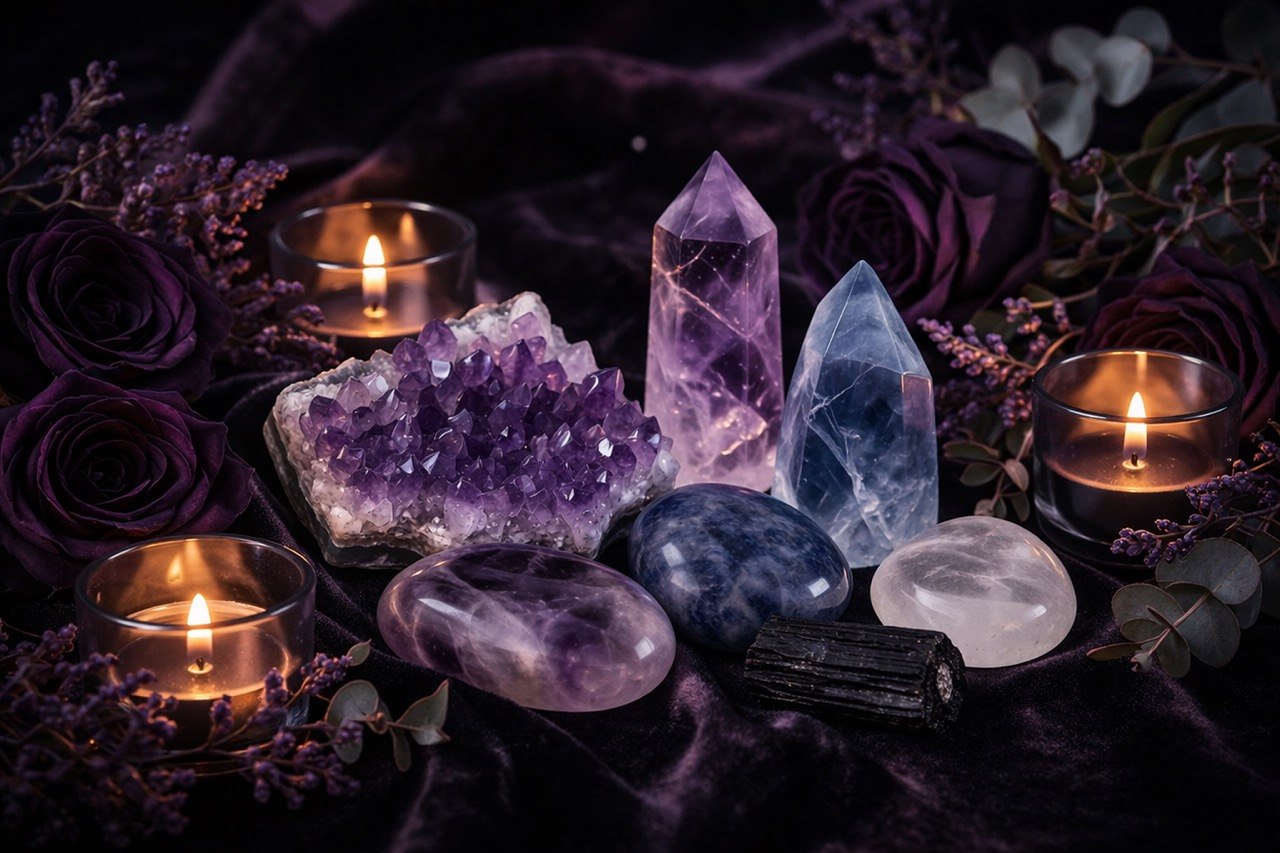
Anxiety is one of the most common struggles today. These crystals work directly with the nervous system to bring calm, clarity, and grounding.
In a world of constant stimulation, anxiety has become a near-universal experience. Many people find that working with certain stones helps regulate their nervous system, quiet the mind, and restore a sense of safety in the body.
Amethyst is the first crystal most people reach for when anxiety strikes. Its violet ray works directly on the mind — slowing racing thoughts, reducing mental chatter, and promoting a sense of serene clarity. Hold it in your left hand during stressful moments and focus on your breath.
Soft, pale blue, and deeply gentle — blue lace agate works on the throat and heart chakras to release tension held in the body. It is especially helpful for social anxiety and the fear of speaking up.
Anxiety often arises when we are ungrounded — too much in our heads, disconnected from the present moment. Black tourmaline anchors you to the Earth, creating a sense of safety and stability.
Lepidolite contains natural lithium. It is one of the most powerful crystals for anxiety, panic attacks, and emotional volatility. Place it on your chest during moments of overwhelm and breathe deeply.
Practical tip: Create an "anxiety kit" — a small pouch with amethyst, black tourmaline, and lepidolite that you carry with you.
Most crystal advice for anxiety describes a general practice, which is not much use when your heart rate is already up. For that, the useful thing about a stone is that it is a physical object with weight and temperature, and both of those give the nervous system something external to attend to.
A practical sequence: hold the stone in one hand and press your thumb into it hard enough to feel the pressure. Name its temperature, its weight, its texture, and whether it is warming. Breathe out for longer than you breathe in, four or five times. This is a standard grounding technique with a crystal used as the anchor object, and it works on the same principle whether or not you attribute anything to the stone.
Acute techniques help in the moment; frequency is what changes a baseline. The most sustainable version is small and attached to something you already do — the stone lives in your left pocket, and every time you notice it you take one slow breath. No sitting, no ritual, nothing to schedule.
People who keep this up for a month usually report that the noticing itself becomes the useful part: it interrupts the drift into rumination often enough to matter.
Anxiety stones work best where anxiety happens. That usually means a pocket rather than a shelf, a desk rather than a display cabinet, and a bedside table rather than a living room. If a particular situation is the problem — commuting, meetings, a specific room — put the stone there rather than in the calmest place in the house.
Amethyst and lepidolite are the usual bedside choices. Black tourmaline suits a desk or a bag. Blue lace agate is small and smooth enough to keep in a pocket without noticing it.
Crystals are a supportive practice, not a treatment. Anxiety that is persistent, that interferes with work, sleep or relationships, or that comes with panic attacks deserves professional attention, and a stone is not a substitute for it. Nothing here should replace medical advice or prescribed treatment.
Used alongside proper support, though, the practice has a real and unmysterious benefit: it builds a habit of pausing, and pausing is most of what grounding techniques are.
Amethyst is the most common choice, with lepidolite for a more stabilising effect and blue lace agate for social anxiety. Black tourmaline suits people who describe their anxiety as ungrounded rather than racing.
Use it as a grounding anchor. Hold it firmly, name its weight, temperature and texture, and breathe out for longer than you breathe in. This is a standard grounding technique with the stone as the focus object.
Wherever the anxiety happens — a pocket, a desk, a bag or a bedside table — rather than on display in the calmest room of the house.
No. Persistent anxiety, or anxiety with panic attacks, deserves professional attention. Crystal practice can sit alongside proper support but is not a substitute for it.