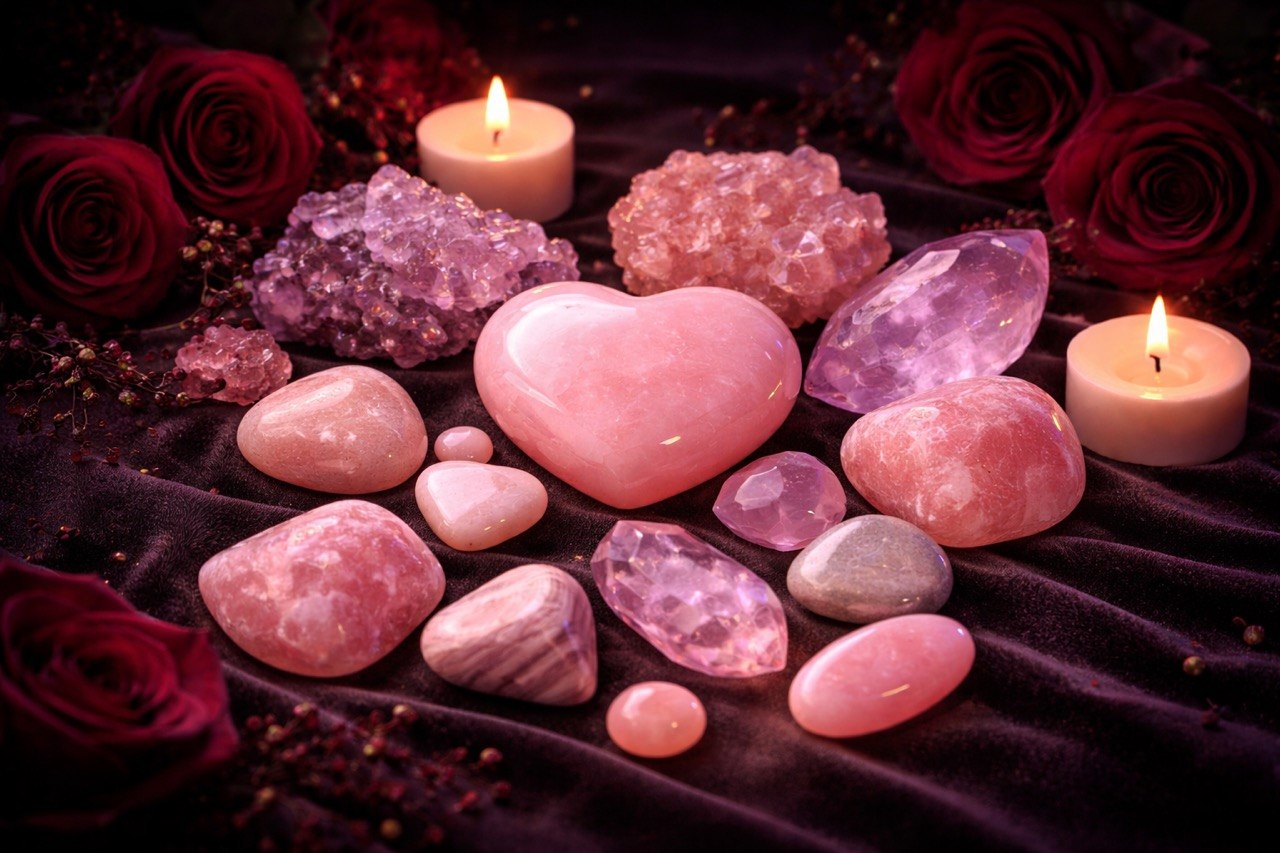
Whether you are looking for love, healing a broken heart, or deepening an existing bond — these crystals can help shift your energy.
Love is the most powerful force in human experience — and crystals have been used as love talismans since ancient Egypt. Whether you want to attract a new relationship, heal after heartbreak, or nurture what you already have, the right stone can help align your energy with what you seek.
No crystal is more strongly associated with love than rose quartz. It opens the heart chakra and radiates gentle, unconditional love energy. It works on all forms of love: romantic, friendship, family, and — most importantly — self-love. Sleep with rose quartz under your pillow, carry it in your pocket, or place it in the relationship corner of your home.
If you are recovering from a painful relationship or loss, rhodonite is your crystal. It heals emotional wounds, releases resentment, and helps you forgive — yourself and others.
When a relationship needs rekindling or you want to attract a passionate, committed partner, garnet is the stone. It activates the root chakra and the heart, connecting physical desire with emotional depth.
If you keep repeating the same patterns in relationships, malachite breaks the cycle. It is a stone of transformation that brings deep emotional patterns to the surface so they can be released.
Tip: Place rose quartz and garnet together on your nightstand to invite both loving warmth and passionate attraction into your life.
Rhodochrosite belongs in any love list, though it points inward rather than outward. It is the stone traditionally used for self-compassion and early wounds — the ones that shape how you behave in relationships long before a particular relationship exists. It is soft, banded pink and cream, and it must be kept dry.
Green aventurine is the other. It is associated with opportunity generally rather than romance specifically, which makes it useful when the obstacle is not the heart but the circumstances — meeting people at all, saying yes to things, being somewhere new.
Every crystal list for love mentions self-love, usually in a sentence, usually last. It deserves better placement, because the practical reports are consistent: people who work with rose quartz or rhodochrosite for their own sake describe more change than those who work with them to attract someone.
That is not mystical. Attention to what you tolerate, what you ask for and how you speak to yourself has obvious downstream effects on relationships. The stone is a daily reminder to pay that attention.
Three approaches account for most practice. Wearing, usually as a pendant near the heart, keeps the stone in contact through the day and suits rose quartz and rhodonite. Placing, on a bedside table or in the bedroom, is the traditional approach for relationship work involving two people. Holding during a short daily sitting is the most deliberate and the one that tends to produce the clearest sense of whether anything is shifting.
Whatever you choose, keep it for several weeks before judging it. Anything shorter is noise.
It is worth being straightforward about this. A stone will not make a specific person want you, and any source promising that is selling something. It will not repair a relationship that one person has left, and it is not a substitute for the conversation you are avoiding.
What the tradition actually claims is more modest and more useful: that carrying something associated with openness makes you slightly more likely to behave openly, and that a daily reminder of what you want makes you slightly more likely to move towards it. That is a real effect, and it does not require the stone to do anything supernatural.
Rose quartz is the traditional choice and the one most people start with. It is associated with openness generally rather than with a specific person, which is the more realistic framing.
No, and any source promising that is selling something. The traditional claim is far more modest — that carrying a reminder of what you want makes you slightly more likely to act on it.
Rhodonite is the usual recommendation for working through resentment and grief, and rose quartz for the gentler side of it. Rhodochrosite suits the deeper self-compassion work that often follows.
Worn near the heart, on a bedside table, or held during a short daily sitting. Give it several weeks before deciding whether it is doing anything.