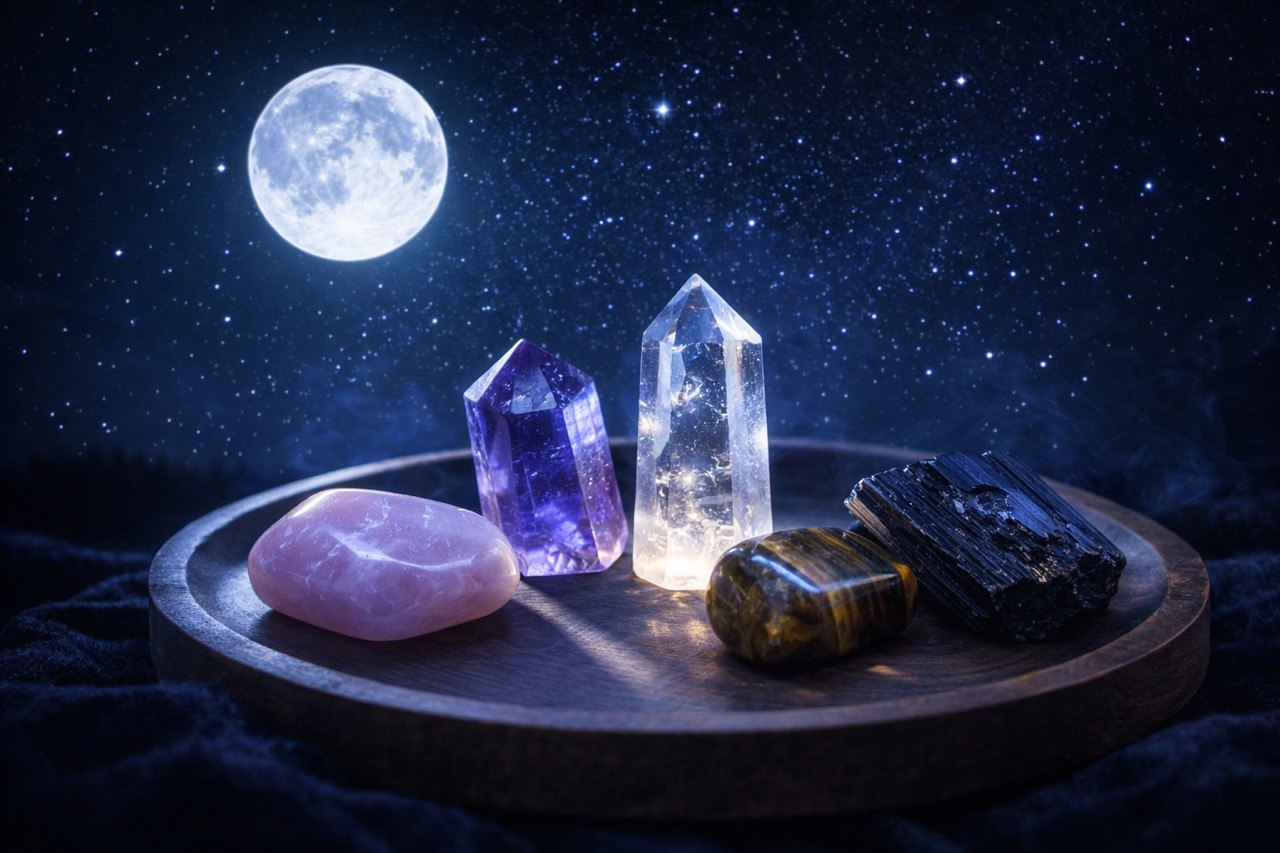
Crystals absorb energy over time and need regular cleansing. Learn the best methods for each stone type.
Crystals work by absorbing, storing, and transmitting energy. Over time they fill up with the energies they've absorbed — and need to be cleared and recharged. Think of it like restarting your phone.
Moonlight: The gentlest and most universal method. Place your crystals outside or on a windowsill during a full moon overnight. Works for all stones.
Running water: Hold your crystal under cold running water for 30–60 seconds, visualizing negativity washing away. Warning — do NOT use this for soft or water-soluble stones like selenite, malachite, or pyrite.
Smoke (smudging): Pass your crystal through the smoke of sage, palo santo, or incense. Ancient and effective for all stone types.
Sound: Use a singing bowl, tuning fork, or even music at 432 Hz. The vibration penetrates and resets the crystal's energy field.
Selenite: Place your crystals on a selenite plate or next to a selenite wand overnight. Selenite is self-cleansing and one of the few crystals that cleanses others.
After cleansing, charge your crystals by placing them in sunlight (a few hours — be careful, some crystals fade in sun), moonlight, or on a bed of natural earth. Then set your intention: hold the crystal, breathe deeply, and state your purpose clearly in your mind.
How often? Once a month at minimum, or whenever a crystal feels "heavy" or less effective than usual.
This is the part of crystal care that does real damage when it is skipped, because the advice to rinse everything is repeated everywhere and it is wrong for a significant number of common stones.
Selenite dissolves — it is gypsum, and even a brief rinse roughens and clouds the surface permanently. Pyrite rusts, and prolonged damp can trigger a progressive breakdown that produces sulfuric acid and destroys the specimen. Malachite and chrysocolla are copper-bearing, react with water and are unsafe to make elixirs from. Turquoise is porous and absorbs water, shifting the blue permanently towards green. Lapis lazuli is porous and its pyrite inclusions rust. Rhodochrosite is a soft carbonate that dissolves slowly. Fluorite, kyanite and the feldspars — moonstone, labradorite, amazonite, sunstone — have cleavage planes that water works into.
The safe rule: if a stone is softer than about 6 on the Mohs scale, or porous, or metallic, keep it dry and use moonlight, sound or dry salt instead.
These three get used interchangeably and they are not the same. Cleansing is clearing — the traditional idea of removing what a stone has picked up. Charging is restoring, usually by exposure to moonlight, sunlight, earth or sound. Programming is setting an intention, which is really about you rather than the stone: holding it, being specific about what you are working on, and doing that consistently.
You can cleanse without charging, and charge without programming. Most people only need the first two on any regular basis.
There is no correct interval, and the honest answer is that it depends entirely on use. A stone that sits on a shelf needs almost nothing. A stone you carry daily, or one you use specifically for protection or emotional work, is usually cleansed weekly by people who work that way. A stone that has been through something intense — a difficult conversation, an illness, a crowded place — gets cleansed afterwards.
Some stones are considered self-cleansing and are used to clear others: selenite and kyanite are the two usually named, which is why selenite slabs and bowls are so common.
This is subjective and worth treating as such, but the descriptions people give are remarkably consistent. A stone that felt lively goes flat or heavy in the hand. You stop reaching for it without deciding to. Its colour looks duller than you remember. You feel a slight reluctance to pick it up.
None of these are measurable, and some have ordinary explanations — dust dulls colour, and habits fade. But they are useful prompts, and cleansing costs nothing.
Selenite, pyrite, malachite, chrysocolla, turquoise, lapis lazuli and rhodochrosite should never be rinsed. Fluorite, kyanite, moonstone, labradorite, amazonite and sunstone tolerate a brief rinse at most. As a rule, anything softer than 6 on the Mohs scale, porous or metallic should stay dry.
It depends on use. A shelf ornament needs almost nothing; a stone carried daily or used for protection is commonly cleansed weekly, and after anything intense. There is no fixed schedule.
Cleansing clears what a stone has picked up. Charging restores it, usually with moonlight, sound or earth. Programming is separate again — setting an intention, which is more about your focus than the stone.
Only some. Amethyst, citrine, rose quartz, fluorite, aquamarine, amazonite and rhodochrosite all fade permanently in sun. Moonlight is safe for everything and is the better default.