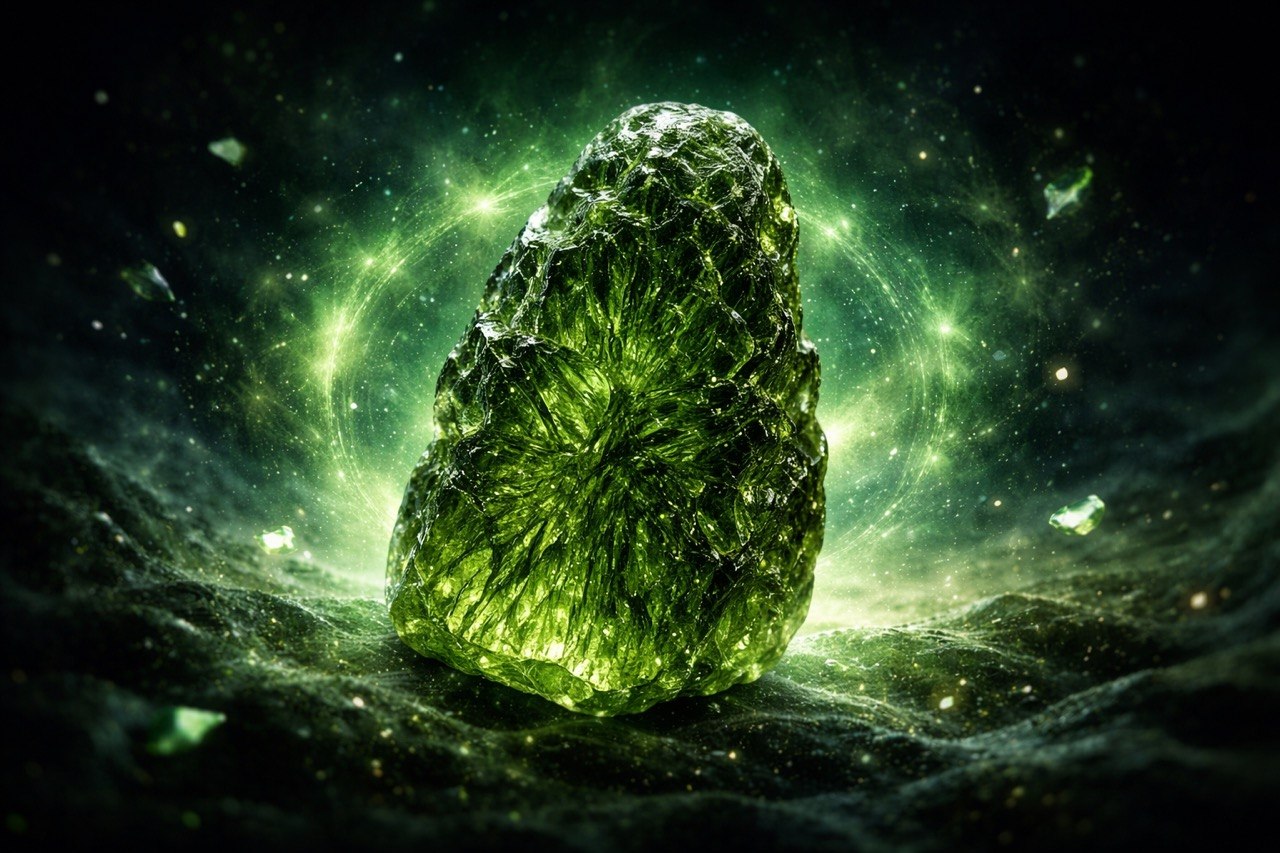
No crystal generates more controversy than moldavite. People report life-changing events within days of acquiring it. What is really going on?
Moldavite is unlike any other stone. It is not from Earth — it is a tektite, a natural glass formed 15 million years ago when a meteorite crashed into what is now Germany. The impact was so violent that molten rock was hurled into the sky and rained back down across Central Europe as glassy droplets.
Almost everyone who holds moldavite for the first time reports something unusual: a sudden warmth, tingling in the hand, a racing heart, or a feeling of being light-headed. This is so common it has a name — the "Moldavite Flush". Skeptics say it's the power of suggestion. Believers say it's the stone's extraordinarily high vibrational frequency.
Users of moldavite consistently describe rapid, sometimes chaotic life changes: relationships ending, career shifts, sudden relocations, unexpected spiritual awakenings. The stone seems to act as an accelerator — whatever is not aligned with your highest path gets cleared away, often dramatically.
Moldavite is not for everyone, and not for every moment in life. If you are in a stable period and ready for growth, it can be extraordinary. If your life is already turbulent, it may amplify the chaos. Start slowly — wear it for short periods and always ground yourself afterward with black tourmaline or obsidian.
One thing is certain: moldavite is never boring. And in a world of ordinary stones, that alone makes it remarkable.
Most moldavite for sale is not moldavite. The fakes are green bottle glass, and they are convincing in photographs and obvious in the hand once you know what to look for.
Genuine moldavite has a matte, deeply etched surface covered in fine wrinkles, pits and channels — the result of falling through the atmosphere and then weathering in soil for fifteen million years. Under magnification you should find hair-thin swirls of lechatelierite, undissolved silica strands trapped in the glass, and irregularly shaped bubbles. The colour is a mossy forest green, often slightly brown, and it varies across a single piece.
Fakes are glossy and smooth, sometimes with a moulded texture that repeats. Their bubbles are perfectly round. Their green is bright, uniform and slightly artificial. And they are cheap, which is the clearest signal of all — genuine moldavite comes from one finite strewn field and the accessible deposits are largely worked out.
Moldavite is not rare in the way marketing usually means. It exists in exactly one place, formed in a single event, and nothing is making more of it. The Czech deposits have been dug for over a century, the best material is gone, and demand rose sharply after moldavite went viral online. Prices have followed, and so has the volume of glass being sold under the name.
This is worth knowing before buying: a large, flawless, cheap piece is not a bargain, it is a different material entirely.
Whatever you make of the reported effects, the practical advice from people who use moldavite regularly is consistent: start short. Minutes rather than hours, held rather than worn, during the day rather than overnight. Many people find that sleeping with moldavite produces vivid or disrupted sleep, and put it in another room after the first attempt.
If it feels like too much, the standard response is to pair it with something grounding — black tourmaline, obsidian or hematite — or simply to put it down. There is nothing to prove by pushing through.
Moldavite is a glass at 5.5 on the Mohs scale, which is softer than quartz and easy to scratch. Never clean it with salt or anything abrasive, and never store it loose with harder stones — a pouch of its own is worth it on a piece that expensive. A brief rinse is fine; the etched surface is the identifying feature and should not be polished away.
Look for a matte, wrinkled, etched surface, mossy and uneven forest green, irregular bubbles and hair-like silica swirls under magnification. Glossy surfaces, bright even green, perfectly round bubbles and a low price all indicate bottle glass.
It formed in a single meteorite impact about 15 million years ago and exists only in one strewn field across the Czech Republic, Austria and Germany. Supply is finite, the best deposits are largely worked out, and demand rose sharply after it went viral online.
Not physically, though it is soft enough to scratch. The common experience is that it feels intense, so most people start with short sessions during the day rather than wearing it constantly or sleeping with it.
Something grounding, if you find it overwhelming — black tourmaline, obsidian or hematite are the usual choices. Amethyst and selenite make it gentler without cancelling it out.