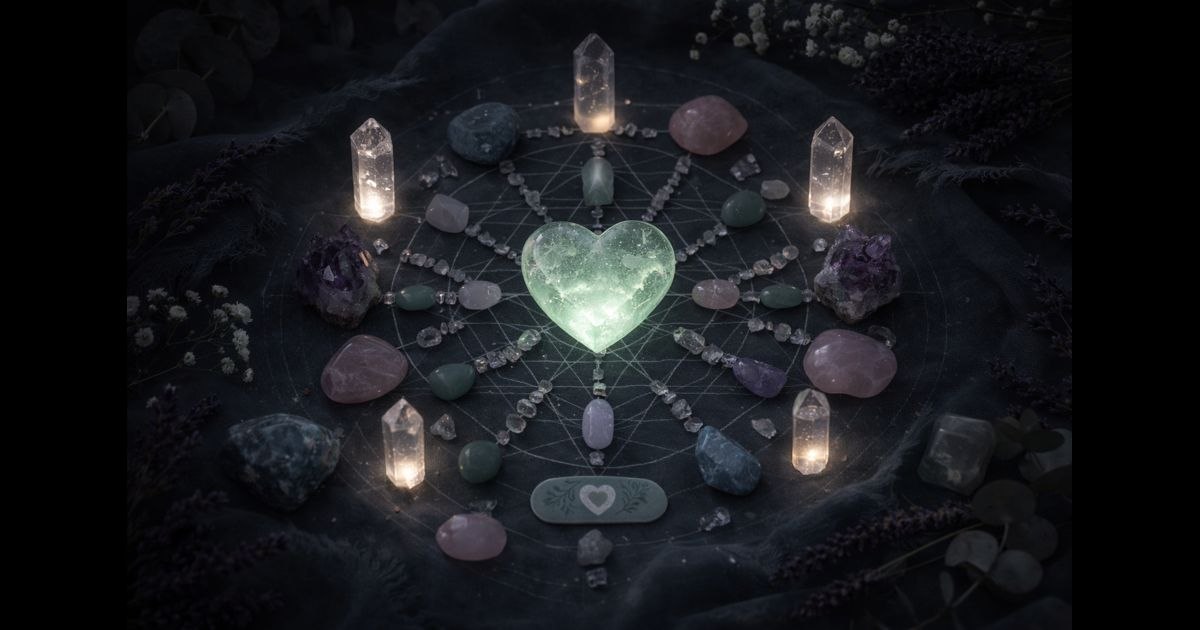
Crystal healing is not a modern trend. Humans have worked with stones for healing, protection, and power for at least 6,000 years.
Virtually every ancient civilisation — Egyptian, Greek, Roman, Chinese, Indian, Mesoamerican — worked with gemstones for healing, ritual, protection, and power.
The Egyptians were perhaps the most sophisticated crystal users in history. Lapis lazuli was ground into eye makeup and used in amulets to invoke divine protection. Turquoise was sacred to Hathor, goddess of love and beauty. Carnelian and malachite were buried with the dead to protect them in the afterlife.
The word "crystal" comes from the Greek krystallos, meaning "ice" — Greeks believed clear quartz was water frozen so hard it could never melt. Amethyst was worn to prevent intoxication. Roman soldiers wore hematite armour for protection in battle.
Jade has been central to Chinese culture for over 5,000 years. It was believed to store qi (life force energy). Today jade is still the most prized gemstone in China, associated with virtue, longevity, and prosperity.
In Ayurvedic medicine, gems are ground into fine powders called bhasmas and prescribed for specific imbalances. This tradition is still practiced in India today.
Interest in crystal healing surged in the 1970s New Age movement and again in the 2010s as wellness culture expanded globally. Today millions of people carry and work with crystals worldwide.
Between the classical world and the modern revival sits a body of writing most crystal histories skip entirely. Lapidaries — catalogues of stones and their attributed powers — were among the most copied texts of the European Middle Ages. Marbode of Rennes wrote one around 1090 that circulated for four hundred years; Hildegard of Bingen produced another in the twelfth century, integrating stones into a broader system of medicine and theology.
These were not fringe documents. They sat in monastery libraries alongside herbals and medical texts, and they treated mineral, plant and prayer as parts of one continuous practice.
The nineteenth century is where the tradition divides. Mineralogy became a rigorous science with classification, crystallography and chemistry, while the same period saw an enormous popular appetite for spiritualism, mesmerism and the occult. Stones ended up on both sides of the line: catalogued in one room and used for scrying in the next.
That split has never really closed, and it explains much of the confusion around crystals today — two traditions with the same objects at the centre and completely different standards of evidence.
It is worth being straightforward. There is no scientific evidence that crystals produce healing effects through any physical mechanism, and the studies that exist point towards expectation rather than mineral. The best-known experiment, by Christopher French and colleagues, found that people reported the same sensations from real and fake crystals when they had been primed to expect them.
That finding is often quoted as though it settles the matter dismissively, but it is more interesting than that: it demonstrates that the reported experiences are real experiences, produced by attention and expectation rather than by quartz. Which is roughly what a memory cue, a placed reminder or a focus object does.
Traditions that survive five thousand years usually do something for the people who keep them. What crystal practice reliably provides is a physical anchor for attention — an object that marks an intention, prompts a pause and makes an abstract commitment tangible.
Those are not small things, and they do not require the stone to have properties. Understood that way, the history stops looking like a long chain of error and starts looking like a very durable technology for holding attention.
The attested use of stones for protection and healing goes back at least five thousand years, with ancient Egyptian, Mesopotamian, Chinese and Indian traditions all documented. The modern Western revival dates from the 1970s.
A medieval catalogue of stones and their attributed powers. Marbode of Rennes wrote a famous one around 1090, and Hildegard of Bingen produced another in the twelfth century. They were among the most copied texts of the period.
No evidence of a physical mechanism. The best-known study, by Christopher French and colleagues, found people reported identical sensations from real and fake crystals when primed to expect them — which suggests the experiences are produced by attention and expectation.
Because the practice provides a physical anchor for attention — an object that marks an intention and prompts a pause. That works regardless of what the mineral does, and it explains the tradition's durability.