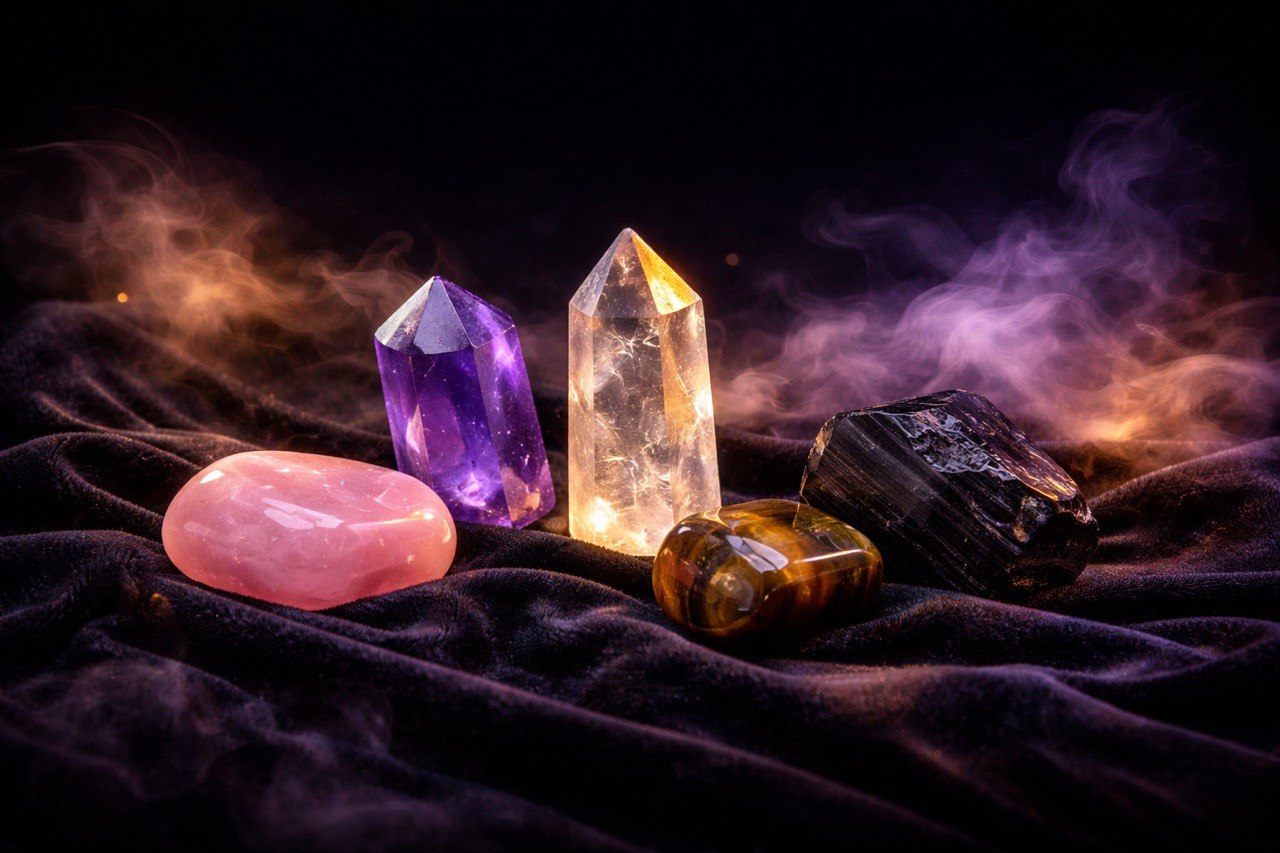
Starting your crystal journey can feel overwhelming. Here are the five most powerful yet gentle stones to begin with.
Beginning your crystal journey is one of the most rewarding steps you can take on a path of self-discovery. But with hundreds of stones to choose from, where do you start?
Amethyst is the perfect first crystal. Calming, protective, and beautiful — it works on the mind, helping with stress, sleep, and intuition. Place it on your nightstand or hold it during meditation.
No crystal collection is complete without rose quartz. It opens the heart chakra and invites love on every level — romantic, self-love, and compassion for others. Carry it with you daily.
A powerful protector against negative energy, anxiety, and stress. Place it by your front door or near your computer to absorb electromagnetic energy. Essential for empaths.
Called the "merchant's stone", citrine brings positivity, motivation, and abundance. Unlike most crystals, it never needs cleansing — it only radiates good energy. Keep it on your desk.
The master healer. Clear quartz amplifies the energy of every other crystal and your own intentions. It is the most versatile stone in existence — if you could only have one crystal, make it this one.
Tip: Trust your instincts when choosing. The crystal that catches your eye or that you feel drawn to is almost always the one you need.
One. It is tempting to buy the whole set at once, and most people do, but a single stone you actually use beats five sitting in a bowl. Working with one crystal for a few weeks teaches you what it feels like to notice a stone at all — whether you reach for it, whether you forget it exists, whether anything shifts. That baseline is impossible to establish when you are carrying four at once and cannot tell which is doing what.
If you already own several, pick one and put the rest away for a month. You can always bring them back.
The crystal market has a lot of dyed, reconstituted and outright synthetic material in it, and beginners are the easiest customers to sell it to. A few rules cover most of the risk. Be suspicious of colours that are too vivid and too even — natural stone is almost always uneven. Be suspicious of a bargain on anything rare; genuine moldavite, larimar and good turquoise are expensive for structural reasons and a cheap one is a fake. Ask sellers directly whether a stone has been dyed, heated or stabilised, and treat a vague answer as a no.
Buying in person is better than online for a first purchase, simply because weight and temperature tell you a great deal. Real stone is cold and heavier than it looks; glass and resin feel light and warm up fast in your hand.
Most beginner disappointment comes from owning a crystal and never using it. Pick one context and repeat it: the stone goes in your pocket every morning, or sits on your desk where you can see it, or goes under the pillow. Hold it for a minute when you notice it. That is the whole practice at the start, and it is enough — the point is building the habit of pausing, not performing a ritual correctly.
Buying too many too fast is the first. Choosing by colour alone rather than by what you actually need is the second. Expecting a stone to do the work on its own is the third, and the most disappointing — crystals are prompts and reminders, and they pair with action rather than replacing it.
The last one is care. Beginners routinely rinse everything in water, which ruins selenite outright, rusts pyrite and dulls turquoise and malachite. Check what a stone can tolerate before it goes anywhere near a tap.
Amethyst, for most people. It is inexpensive, widely available, hard enough to survive being carried around, and useful for the things beginners usually want help with — stress, sleep and a busy mind.
One. Working with a single stone for a few weeks teaches you far more than owning five, because you can actually tell what is doing what.
Weight and temperature give away most fakes: real stone is cold and heavier than it looks, while glass and resin feel light and warm quickly. Be sceptical of colours that are unnaturally vivid and perfectly even.
Most people do, on the principle that it has passed through many hands. Check the stone first — selenite, pyrite, malachite and turquoise should never be rinsed in water. Moonlight or sound is safe for everything.