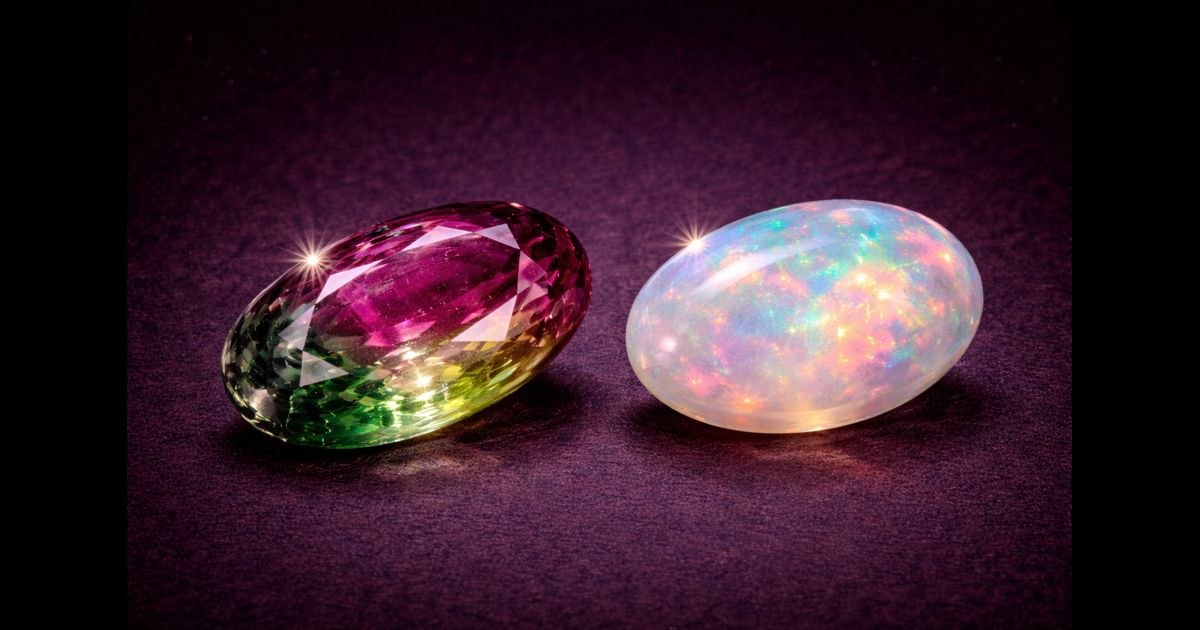
Opal – Stone of Inspiration
Opal is a hydrated amorphous form of silica – it contains between 3% and 21% water within its structure. It is not a crystalline mineral but a mineraloid. Its celebrated "play of colour" (called opalescence) is caused by the diffraction of light through a regular array of silica spheres. Australia produces over 95% of the world's fine opals.
Opals are divided into Precious Opals (which show play-of-colour) and Common Opals (which don't). The most prized is Black Opal from Lightning Ridge, New South Wales, where vivid flashes of colour blaze against a dark body. Boulder Opals and Crystal Opals are also highly valued.
Opal Meaning & Properties
Opal is associated with the crown chakra and the full spectrum of the chakra system – it reflects and amplifies moods and emotions, intensifying the inner state of whoever wears it. The Romans called it opalus – "precious stone." Ancient Arabic legend says opals fell from the sky in lightning flashes.
Opal is a stone of inspiration, creativity, and spontaneous insight. It enhances cosmic consciousness and stimulates originality and creativity. It is also known as a stone of "happy dreams and changes" – bringing lightness and optimism to the spirit.
Tourmaline – Stone of Every Colour
Tourmaline is a boron silicate mineral that occurs in more colours than any other gemstone – from the hot "Paraíba" blue-green of Brazil to deep Rubellite red, violet, yellow, and the multicoloured "watermelon" tourmaline with its pink core and green rind.
Pink and red Tourmaline (Rubellite) is the most popular for October – it activates the heart chakra, promotes compassion, healing, and self-love. Black Tourmaline (Schorl) is one of the most powerful protective stones known. The word "tourmaline" comes from Sinhalese turmali – "stone of mixed colour."
How to Wear and Use October's Stones
Opal and tourmaline are opposites. Opal is fragile, temperamental and mesmerising, its play of colour never repeating. Tourmaline is durable, fine for daily wear at 7 to 7.5, and comes in the widest colour range of any gemstone, including the two-tone watermelon variety.
Opal is better in a pendant or earrings — in a ring it collects chips quickly. Black tourmaline, schorl, is generally not worn as jewellery at all but kept nearby or at home as a protective stone.
October Zodiac Signs and Their Stones
Libra until 22 October, Scorpio from the 23rd. Opal is traditionally given to Libra for its changeability and its pull towards harmony, while Scorpio is more often pointed at black tourmaline and obsidian — stones of protection and depth.
October's pairing is convenient precisely because it covers both signs: the light opal for Libra, the dark tourmaline for Scorpio.
How to Cleanse and Charge October's Stones
Opal needs particular handling, and the reason is its composition: it contains between 3 and 20 percent water. Because of that it fears dryness — in low humidity or after a sharp temperature change it develops a network of fine cracks called crazing, and the stone cannot be recovered. Keep it away from ultrasonic cleaners, steam, long soaks, radiators and dry air. Wipe with a soft damp cloth.
Tourmaline is easier: a brief rinse is safe. One curiosity — it is pyroelectric, so warmth and friction give it a charge that attracts dust, which makes it seem to get dirty faster than other stones.
How to Spot Fake October Stones
Opal is faked more than most. Opalite, ordinary glass with a milky glow, is everywhere, as are composite stones: doublets and triplets, where a thin slice of real opal is glued to a dark backing and sometimes capped with quartz. Look at the stone from the side — a composite shows a straight glue line, while a solid opal has irregular transitions.
Real opal's play of colour shifts as you turn it and comes in patches of varying shape; opalite glows evenly from every angle. Tourmaline is rarely faked, though dyed glass is sold under the name — bubbles and the absence of the characteristic lengthwise striations give it away.
Questions People Ask
What is the birthstone for October?
Opal and tourmaline. Tourmaline was added later as a more affordable and considerably more durable alternative to fragile opal.
Can opal go in water?
Better not. Opal contains 3 to 20 percent water and is harmed by both soaking and drying out. Ultrasonic cleaners, steam, radiators and dry air all cause permanent crazing.
Why has my opal cracked?
Most likely dryness or a sharp temperature change. It is called crazing and it is irreversible. Keep opal away from radiators, sunny windowsills and very dry rooms.
How do I tell a solid opal from a doublet?
Look at the stone from the side. A doublet or triplet shows a straight glue line between the thin opal slice and its dark backing. A solid stone has irregular transitions.
Where to get Opal
If you want to wear or work with Opal as a physical stone, here are three forms commonly used.
As an Amazon Associate, we earn from qualifying purchases.