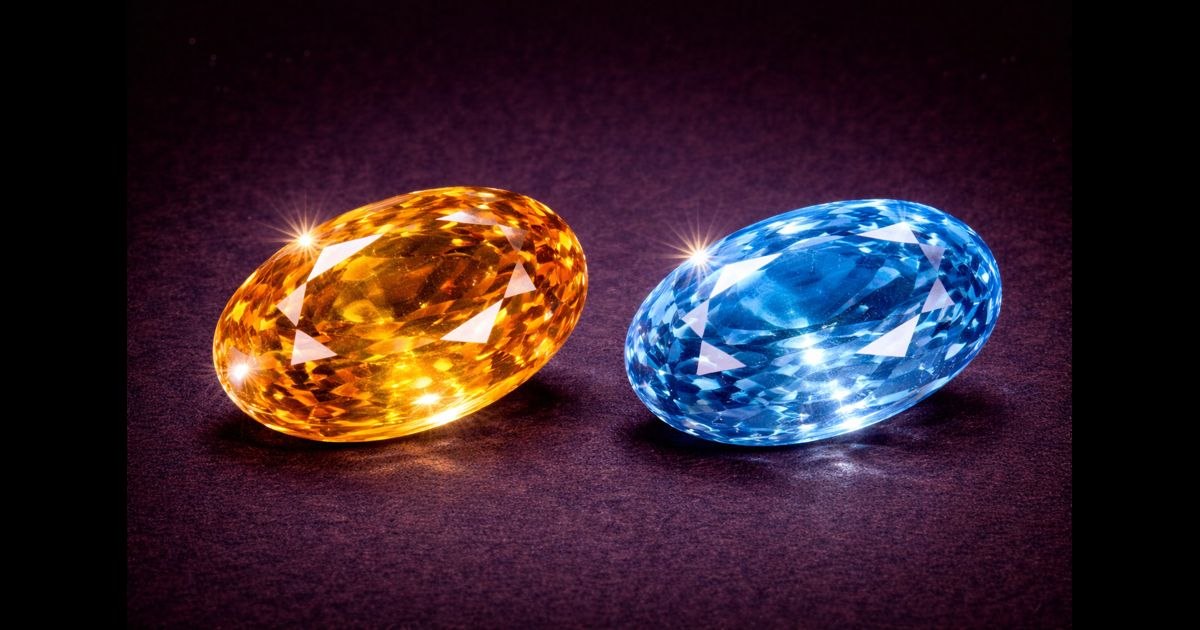
Citrine – The Merchant's Stone
Citrine is a yellow to orange-red variety of quartz, coloured by iron impurities. Natural citrine is relatively rare – most citrine sold commercially is heat-treated amethyst, which turns from purple to yellow-orange at around 470°C. The finest natural citrines come from Brazil, particularly the state of Rio Grande do Sul.
The name comes from the French citron (lemon). It has been used in jewellery for at least 6,000 years – examples have been found in ancient Greek and Roman artefacts. Scotland and Bavaria have historic traditions of citrine jewellery dating to the 17th century.
Citrine Meaning & Properties
Citrine is called the "Merchant's Stone" or "Success Stone" – it is associated with wealth, abundance, and manifestation. Unlike most crystals, citrine is said never to accumulate negative energy and never needs cleansing. It carries the energy of the Sun – warming, energising, and highly creative.
Associated with the solar plexus chakra, citrine enhances personal power, self-confidence, and motivation. It attracts wealth, prosperity, and success. It is a stone of positivity and optimism – it helps transform negative energy into positive before it can be absorbed.
Topaz – Stone of Joy
Topaz is an aluminium silicate fluoride hydroxide mineral. It occurs in a wide variety of colours – the rarest and most valuable is "Imperial Topaz," a golden orange-yellow to orange-pink. Blue Topaz (usually enhanced by irradiation) is the most commonly sold variety today.
The name is thought to derive from the Sanskrit tapas (fire) or from Topazios, an ancient Greek island in the Red Sea. In antiquity, all yellow stones were called topaz – leading to much historical confusion. Topaz is associated with joy, generosity, abundance, and good health. It supports honesty, forgiveness, and the manifestation of intentions.
How to Wear and Use November's Stones
November's stones share a warm golden tone but behave differently. Citrine is quartz at hardness 7 — inexpensive, tough and fine for daily wear. Topaz is harder at 8, but it has perfect cleavage and splits from a precise knock, so the higher number does not make it the more practical stone.
Citrine is traditionally kept where work happens and money moves: on a desk, in a till, in a wallet. That is its most durable application, inherited from its old name, the merchant's stone.
November Zodiac Signs and Their Stones
Scorpio until 21 November, Sagittarius from the 22nd. Topaz is traditionally given to Sagittarius for optimism and breadth, while Scorpio sits closer to black tourmaline, obsidian and garnet — stones of depth and protection.
Citrine is considered to suit both: lightness for Scorpio, focus on the practical result for Sagittarius.
How to Cleanse and Charge November's Stones
Both stones fade in sunlight, and that is the main thing to know about them. Citrine loses its golden colour to ultraviolet permanently, and so does topaz — irradiated blue topaz can shift particularly noticeably. Charge them by moonlight, not on a windowsill.
Citrine handles a brief rinse in cool water without difficulty. Topaz additionally dislikes heat and ultrasonic cleaning: perfect cleavage leaves it vulnerable to vibration and thermal shock.
How to Spot Fake November Stones
Almost all citrine on the market is heat-treated amethyst, and it is not hard to recognise. Treated material has a saturated orange-amber tone concentrated near the crystal tips with a whitish or clear base, and clusters often look faintly burnt. Natural citrine is noticeably paler, a smoky lemon, and coloured far more evenly.
With topaz the confusion is mostly in the naming: citrine and smoky quartz are sold as topaz in volume, and mystic topaz is coated quartz. Real topaz is appreciably heavier than quartz of the same size — the density difference is noticeable in the hand.
Questions People Ask
What is the birthstone for November?
Citrine and topaz. Both are warm and golden, but citrine is the more practical for daily wear, while topaz is more brittle despite being harder, because of its perfect cleavage.
Is my citrine natural or heat-treated amethyst?
Look at the colour. Heat-treated amethyst is a saturated orange-amber at the tips with a whitish base and often a burnt look. Natural citrine is paler and more evenly coloured, a smoky lemon.
Does citrine fade in sunlight?
Yes, and so does topaz. Ultraviolet light permanently destroys the colour in both, so charge them by moonlight rather than on a windowsill.
Why did my topaz break?
Perfect cleavage. Topaz is hard but splits along an internal plane from a precise knock, vibration or thermal shock. Ultrasonic cleaning is not safe for it.
Where to get Citrine
If you want to wear or work with Citrine as a physical stone, here are three forms commonly used.
As an Amazon Associate, we earn from qualifying purchases.