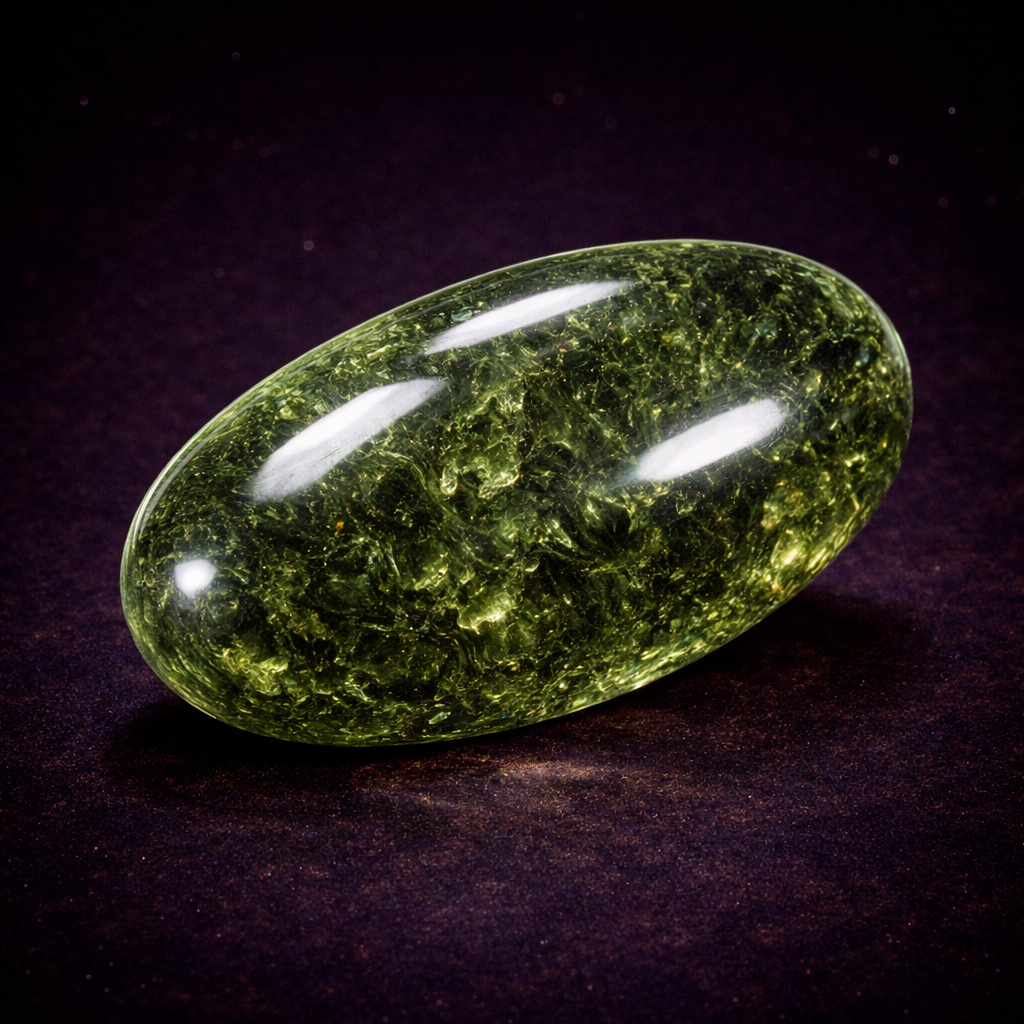
Origins & Geology
Found in: Czech Republic (Bohemia, Moravia)
Moldavite is a natural glass formed approximately 15 million years ago during a meteorite impact in southern Germany. The heat of the impact melted terrestrial rock, which was ejected and cooled mid-air into glassy fragments scattered across Central Europe. It is classified as a tektite – not a mineral, but a natural glass of cosmic origin.
Moldavite Meaning & Healing Properties
Known as the 'stone of transformation', moldavite carries an extraordinarily high vibration unlike any Earth mineral. It accelerates spiritual evolution, breaks patterns, and catalyzes rapid change – sometimes dramatically. Many people feel heat or tingling upon first contact. It is said to connect the bearer to higher dimensions and extraterrestrial energies.
How to Use Moldavite
- Accelerating spiritual growth
- Breaking old patterns and habits
- Deep meditation and astral work
- Connecting with cosmic consciousness
- Rapid personal transformation
Moldavite Facts
- Only found in a strewn field across Czech Republic, Austria and Germany
- Moldavite is becoming increasingly rare – supplies are finite
- Many people experience the 'moldavite flush' – a rush of heat upon holding it
- Fake moldavite is extremely common – always buy from trusted sources
How to Cleanse and Charge Moldavite
Moldavite is a natural glass, so water does not harm it, but at 5.5 on the Mohs scale it is softer than quartz and scratches easily — never clean it with salt, grit or an abrasive cloth, and keep it away from harder stones in a pouch or a lined box. Its etched, wrinkled surface is the whole point of the stone and a polished or tumbled piece has lost most of what makes it identifiable. Rinse briefly, pat dry, and charge it by moonlight or with sound rather than anything physical.
How to Spot Fake Moldavite
Fake moldavite is everywhere, and most of it is green bottle glass. Real moldavite has a matte, deeply etched surface covered in fine wrinkles and pits created as it fell through the atmosphere and was then weathered in soil for millions of years. Under magnification you should see hair-thin swirls of lechatelierite — undissolved silica strands — and irregular bubbles. Fakes look glossy, feel too smooth, have perfectly round bubbles, and are often a bright uniform green rather than the mossy forest tone of the real thing. Price is the other signal: genuine moldavite is finite and expensive, so a cheap large piece is almost certainly glass.
What to Pair Moldavite With
Moldavite is usually the loudest stone in any pairing, so most people work it alongside something steadying rather than something equally intense. Black tourmaline or obsidian will ground the effect if you find it overwhelming. With amethyst or selenite it becomes gentler and easier to sit with. Pairing it with other high-vibration stones is a matter of taste — some people love moldavite with clear quartz, others find the combination far too much to hold for long.
Questions People Ask About Moldavite
Why is moldavite so expensive?
It exists only in one strewn field across the Czech Republic, Austria and Germany, formed in a single meteorite impact about 15 million years ago. The supply is finite, the accessible deposits are largely worked out, and demand rose sharply after moldavite went viral online.
How can I tell if my moldavite is real?
Look for a matte, wrinkled, etched surface, mossy forest-green colour, irregular internal bubbles and hair-like silica swirls. Glossy surfaces, bright uniform green, perfectly round bubbles and a low price all point to bottle glass.
What is the moldavite flush?
The rush of heat, tingling or light-headedness many people report on first holding moldavite. It is not universal, and if it feels like too much, put the stone down and work with it in short sessions.
Can moldavite go in water?
A brief rinse is fine — it is glass. Do not clean it with salt or anything abrasive, as at 5.5 hardness it scratches far more easily than quartz.
Where to get Moldavite
If you want to work with Moldavite as a physical stone, here are three forms commonly used.
As an Amazon Associate, we earn from qualifying purchases.