Origins & Geology
Found in: Sri Lanka, India, Madagascar, Myanmar
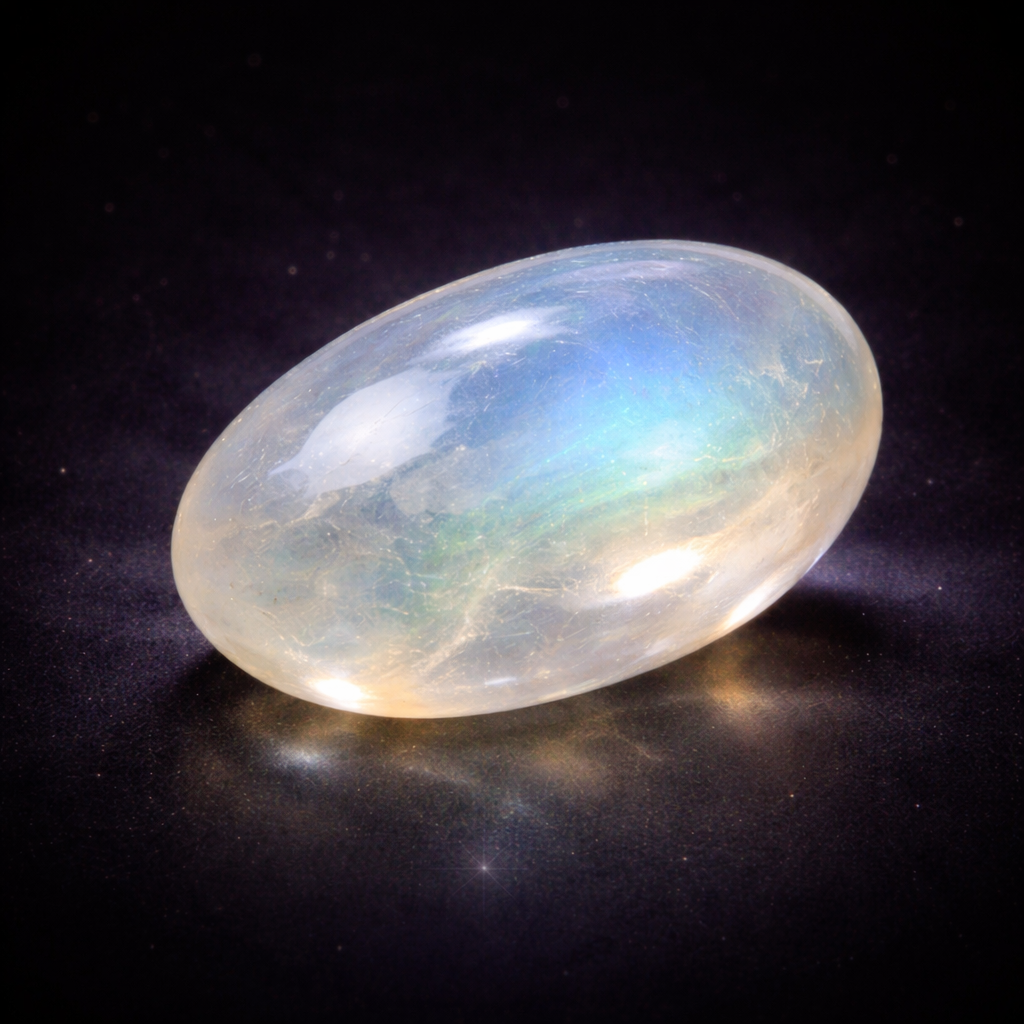
Moonstone is a feldspar mineral exhibiting adularescence – a floating, billowy light effect caused by light scattering between microscopic layers of albite and orthoclase within the stone. The finest specimens show a blue shimmer against a colorless or peach body. It has been used in jewelry for thousands of years.
Moonstone Meaning & Healing Properties
Sacred to moon goddesses across many cultures, moonstone governs cycles, intuition, and the tides of emotion. It enhances feminine energy, fertility, and empathy. Travelers and lovers have carried it for centuries as a talisman. It is said to reveal the truth of any situation when held under moonlight.
How to Use Moonstone
- Connecting with lunar energy and cycles
- Enhancing intuition and psychic gifts
- Supporting fertility and feminine health
- Protection for travellers
- New beginnings and fresh starts
Moonstone Facts
- In India, moonstone is considered a sacred 'dream stone' bringing beautiful visions
- The finest blue moonstones come from Sri Lanka
- Romans believed moonstone was formed from solidified moonbeams
- Moonstone is one of June's three birthstones
How to Cleanse and Charge Moonstone
Moonstone is a feldspar with pronounced cleavage — planes along which it splits cleanly — so it is more fragile than its hardness of 6 to 6.5 suggests. A knock on a hard surface can chip it, and long soaks or hot water can work into those cleavage planes. Rinse briefly in cool water and dry it properly. Salt will dull the polish that produces the shimmer, so avoid it. Moonlight is the natural charging method and does the stone no harm at all.
How to Spot Fake Moonstone
The usual substitutes are opalite and milky glass. The test is the shimmer itself: real moonstone shows adularescence, a soft blue-white light that appears to float below the surface and moves as you tilt the stone, because it is caused by light scattering between microscopic mineral layers. Opalite glows a flat, even blue from the whole surface and does not shift with the angle. Glass imitations often contain round bubbles, and both fakes feel lighter and warm up in the hand faster than real stone. Take care with the name too — much of what is sold as rainbow moonstone is actually white labradorite.
What to Pair Moonstone With
Moonstone sits naturally with other lunar and intuitive stones. With selenite it makes a very calm, distinctly moon-associated pairing. With labradorite it becomes more protective and better suited to change and transition. Rose quartz softens it towards the heart, which is why the two are often worn together for fertility and relationship work. Because moonstone follows cycles rather than pushing, it pairs badly with stones people describe as forceful — carnelian or moldavite tend to overwhelm it.
Questions People Ask About Moonstone
Can moonstone go in water?
Briefly. It is reasonably hard but has strong cleavage, so avoid soaking it, hot water and salt water — all of which can work into the natural splitting planes in the stone.
What causes the blue shimmer in moonstone?
An effect called adularescence. Light scatters between microscopic alternating layers of albite and orthoclase inside the stone, producing a glow that seems to float beneath the surface and move as you tilt it.
Is rainbow moonstone real moonstone?
Usually not. Most stone sold as rainbow moonstone is white labradorite. It is a genuine and beautiful stone, just a different mineral, and it tends to flash in broader colours than true moonstone.
Who should wear moonstone?
It is traditionally linked to Cancer, Libra and Scorpio, and to anyone working with cycles, intuition, fertility or new beginnings. Travellers have carried it as a protective talisman for centuries.
Where to get Moonstone
If you want to work with Moonstone as a physical stone, here are three forms commonly used.
As an Amazon Associate, we earn from qualifying purchases.