Origins & Geology
Found in: Iran, USA (Arizona, New Mexico), China, Egypt
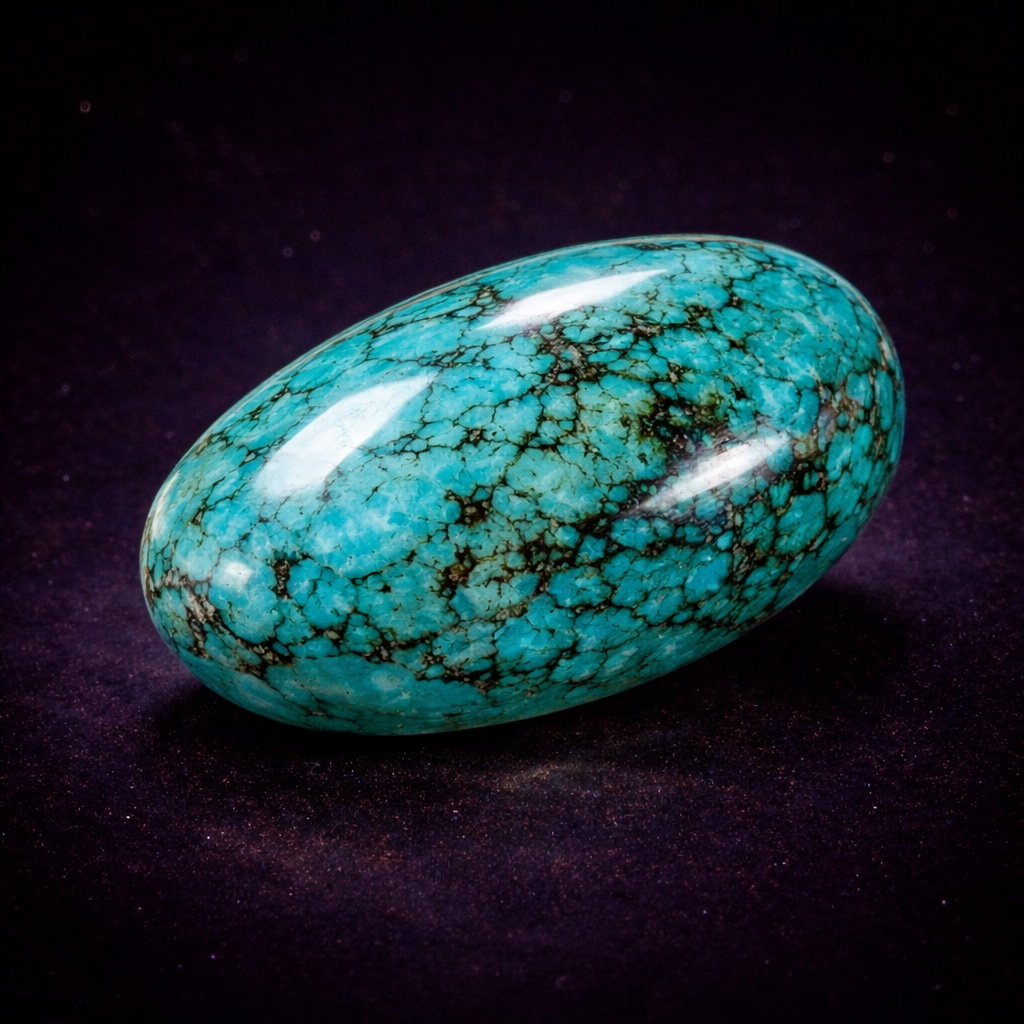
Turquoise is a hydrated phosphate of copper and aluminum, formed in arid regions where water percolates through copper-rich rock. Its color ranges from sky blue to green depending on copper and iron content. One of the oldest known gemstones, it has been mined in Iran's Nishapur region for over 2,000 years. The name comes from the French 'pierre turquoise' – Turkish stone.
Turquoise Meaning & Healing Properties
Sacred to Native American, Persian, Egyptian, and Aztec cultures, turquoise is among the most universally revered protective stones. It is a stone of wholeness and truth, communication and healing. Apache warriors attached it to bows for accuracy. The Navajo believe turquoise is a piece of the sky that fell to earth.
How to Use Turquoise
- Protection and safety during travel
- Clear and honest communication
- Healing and wholeness
- Connecting sky and earth energies
- Strengthening friendships
Turquoise Facts
- December birthstone
- Turquoise adorns Tutankhamun's golden death mask
- The Navajo, Zuni, and Hopi peoples consider turquoise the most sacred of all stones
- True Persian turquoise from Iran is the world standard for quality
How to Cleanse and Charge Turquoise
Turquoise is porous, relatively soft at 5 to 6, and chemically sensitive, which makes it one of the more demanding stones to own. It absorbs water, oils, perfume, sweat and cosmetics, and absorbed liquid turns the classic sky blue towards a dull green over time — a change that cannot be reversed. Never soak it, never use salt, and take rings off before washing your hands. Sunlight and heat also fade it. Clean it with a dry or barely damp soft cloth, and if you wear it, put it on last after perfume and lotion have dried.
How to Spot Fake Turquoise
Very little inexpensive turquoise is what it claims to be. Dyed howlite and dyed magnesite are the standard substitutes, and both take blue dye convincingly while keeping a natural-looking grey web. Genuine turquoise has irregular matrix — the host-rock veining — that varies in width and colour, and its blue is rarely perfectly even. Dyed howlite shows a more uniform, spidery grey web and colour that concentrates in the veins rather than the body. Stabilised turquoise, which is real stone impregnated with resin for durability, is extremely common and legitimate as long as it is disclosed.
What to Pair Turquoise With
Turquoise is a throat-chakra and protection stone with a long history as a travellers' amulet, so it pairs naturally with lapis lazuli for communication and with black tourmaline for protection. Carnelian warms it. Because it is fragile and reactive, it is usually kept in a soft pouch of its own rather than mixed loose with harder crystals.
Questions People Ask About Turquoise
Can turquoise go in water?
No. It is porous and will absorb water, which permanently shifts the blue towards green. Keep it away from soaking, salt, perfume and lotion, and wipe it with a dry cloth instead.
Why has my turquoise turned green?
Absorption. Turquoise takes up water, oils and skin chemistry over time, and that changes the colour. Some people value the resulting patina; it cannot be undone either way.
Is my turquoise dyed howlite?
Check the veining. Real turquoise has irregular matrix that varies in width and tone. Dyed howlite shows an even, spidery grey web with dye concentrated in the cracks and a more uniform body colour.
What is stabilised turquoise?
Genuine turquoise impregnated with resin to harden it and hold the colour. It is a legitimate and very common treatment — the issue is only when it goes undisclosed.
Where to get Turquoise
If you want to work with Turquoise as a physical stone, here are three forms commonly used.
As an Amazon Associate, we earn from qualifying purchases.