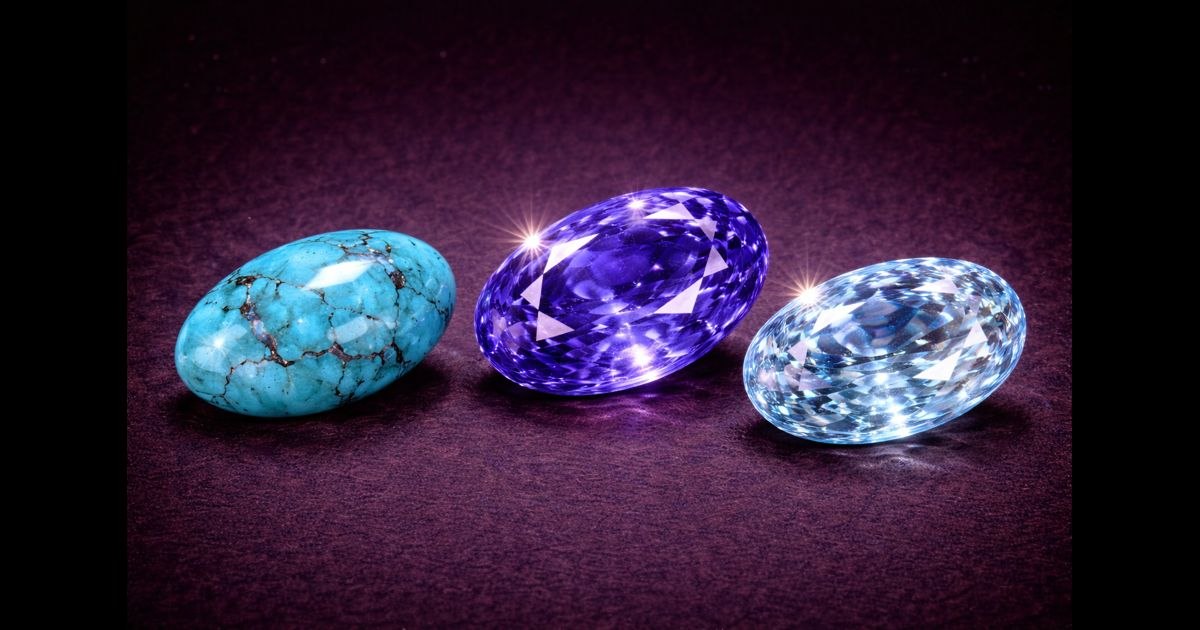
Turquoise – The Ancient Sky Stone
Turquoise is one of the oldest gemstones in the world, mined for over 6,000 years. It is a hydrous phosphate of copper and aluminium, ranging in colour from sky blue to green depending on copper and iron content. The finest "robin's egg" blue turquoise comes from the Nishapur region of Iran (Persian turquoise). American turquoise – from Nevada, Arizona, and New Mexico – is revered by Native American cultures.
Turquoise bridges heaven and Earth – it is a stone of communication, protection, and wholeness. Native American traditions regard it as the stone of the sky – a sacred talisman of protection and power. Ancient Egyptians buried their pharaohs with turquoise, and it adorns the tomb of Tutankhamun. It is associated with the throat chakra and the capacity for honest, clear expression.
Tanzanite – Stone of One Place
Tanzanite is found in only one place on Earth – a tiny area of northern Tanzania, near the base of Mount Kilimanjaro. A blue-purple variety of the mineral zoisite, it was discovered in 1967 by Maasai tribesman Ali Juuyawatu and brought to international attention by Tiffany & Co., who named it Tanzanite. The known deposits may be exhausted within 20–30 years.
Tanzanite displays strong trichroism – it appears blue, violet, and burgundy depending on the viewing angle. In metaphysical tradition it is a stone of spiritual awakening, psychic gifts, and the journey through transformation. It opens the third eye and crown chakras and facilitates communication between the physical and spiritual realms.
Zircon – The Oldest Mineral
Zircon is one of the oldest minerals on Earth – some crystals date back 4.4 billion years. It is a zirconium silicate that occurs in many colours; blue zircon (enhanced by heat treatment) is the most popular birthstone variety. Despite its name, zircon is entirely distinct from the synthetic cubic zirconia used as a diamond simulant.
Zircon promotes wisdom, honour, and prosperity. Its brilliance rivals diamond, and it was widely used in Victorian jewellery. In the Vedic tradition, zircon was considered a substitute for hessonite garnet and associated with Saturn – grounding, discipline, and the bringing of ancient wisdom into the present.
How to Wear and Use December's Stones
December has one of the widest sets, and all three stones share a cool blue tone. Turquoise is the oldest traveller's amulet there is, porous and soft. Tanzanite was only discovered in 1967, in a single location on the planet at the foot of Kilimanjaro. Zircon is a natural stone with tremendous fire, routinely confused with man-made cubic zirconia, though the two have nothing to do with each other.
None of the three suits a ring worn daily. Earrings and pendants are wiser, and turquoise should go on last, after cosmetics and perfume.
December Zodiac Signs and Their Stones
Sagittarius until 21 December, Capricorn from the 22nd. Turquoise is traditionally given to Sagittarius as the stone of the road and of protection in transit, while Capricorn is more often pointed towards garnet and onyx — stones of endurance.
Tanzanite, being a new stone, has no settled zodiac attachment, which makes it the case where choosing simply by what appeals is the honest approach.
How to Cleanse and Charge December's Stones
Turquoise is porous and absorbs everything: water, oil, perfume, cream, sweat. Absorbed moisture shifts the sky blue permanently towards a dull green. It must not be soaked or cleaned with salt, and rings should come off before washing your hands. Most turquoise on the market is resin-stabilised — a legitimate and common treatment, but one that also dislikes chemicals.
Tanzanite has perfect cleavage, so ultrasonic cleaners, steam and knocks are all out. Zircon at 6 to 7.5 has brittle facet edges that abrade quickly, and it fades in sunlight as well.
How to Spot Fake December Stones
Turquoise is faked more than any other stone here: almost all cheap turquoise is dyed howlite or magnesite. Real turquoise has irregular matrix veining that varies in width and tone, and its blue is never perfectly even. Dyed howlite shows a regular, spidery grey web with dye pooling in the cracks.
Zircon is confused with cubic zirconia, though they are fundamentally different materials: zircon is natural and doubly refractive, so the far facet edges double, while cubic zirconia is lab-grown and shows no such effect. Tanzanite is imitated with dyed glass and synthetic forsterite; real tanzanite is pleochroic, appearing blue, violet and burgundy from different angles.
Questions People Ask
What is the birthstone for December?
Turquoise, tanzanite and zircon, with lapis lazuli sometimes added. The wide choice comes from December's list being revised more often than most.
Can turquoise go in water?
No. Turquoise is porous and absorbs water, oils and cosmetics, which turns the blue permanently green. Take rings off before washing your hands.
Why has my turquoise turned green?
It absorbed moisture, oil or skin chemistry. The change is irreversible, though some people value the resulting patina. It is exactly why most turquoise is resin-stabilised.
Are zircon and cubic zirconia the same thing?
No, they are fundamentally different. Zircon is a natural mineral; cubic zirconia is a lab-grown diamond substitute. Zircon doubles the far facet edges, cubic zirconia does not.
Where to get Turquoise
If you want to wear or work with Turquoise as a physical stone, here are three forms commonly used.
As an Amazon Associate, we earn from qualifying purchases.