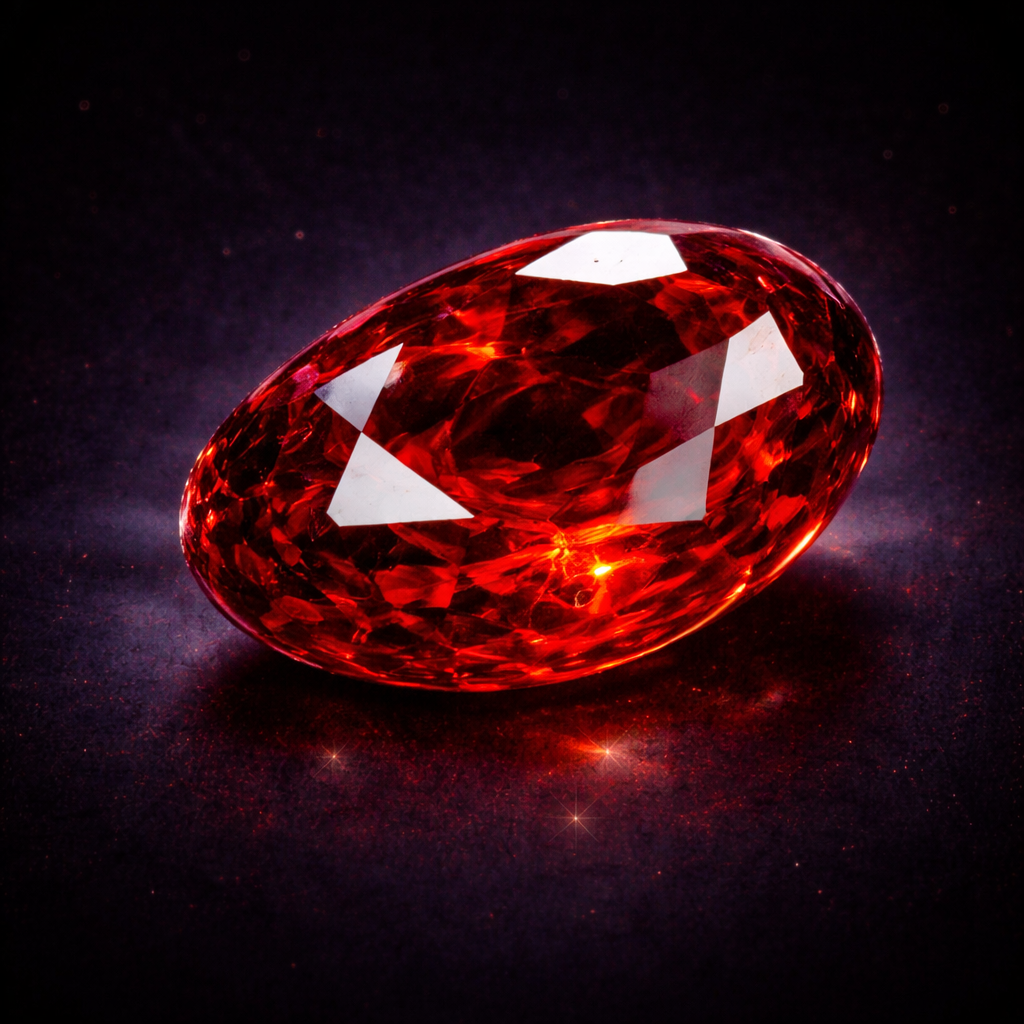
About Garnet
Garnet is not a single mineral but a group of closely related silicate minerals that share the same crystal structure. The name comes from the Latin granatus ("seed-like"), a reference to its resemblance to pomegranate seeds. While the deep red variety is most iconic, garnet occurs in nearly every colour – including rare green Tsavorite and colour-changing Alexandrite-like varieties.
The most common jewellery garnet – Almandine – gets its rich red-to-brown-red colour from iron and aluminium. Pyrope garnet, the brilliant "fiery" variety, contains magnesium and iron. Both have been prized throughout history across cultures from Ancient Egypt to the Renaissance courts of Europe.
Garnet Meaning & Symbolism
Garnet has long been associated with the energy of the root chakra – the seat of survival, vitality, and groundedness. It is considered a stone of commitment, devotion, and passionate love. Ancient Romans exchanged garnet signet rings as tokens of friendship.
In metaphysical tradition, garnet is used to regenerate, revitalise, and re-energise. It is said to balance energy, bring serenity or passion as appropriate, and inspire love and devotion. It is believed to activate other crystals around it, amplifying their energy.
Healing Properties
Emotional
Garnet helps dissolve emotional patterns based in fear, crisis thinking, or survival mode. It brings warmth, devotion, understanding, trust, and sincerity. Especially helpful during times of crisis – it is said to strengthen survival instinct and bring courage.
Physical
Traditionally associated with blood, the heart, and circulation. Healers have long used red garnet for regeneration, detoxification, and strengthening the immune system. Its warming energy is said to support the spine and bones.
Spiritual
Garnet opens the root chakra, grounding spiritual energy into the physical body. It helps anchor the lessons of past lives and supports spiritual transformation by clearing old patterns.
History & Lore
Garnet has been found in jewellery dating back to 3,100 BC in Egypt. It was a favourite stone of the ancient Romans, who used it extensively in signet rings, beads, and decorative carvings. During the Middle Ages, garnet was believed to cure depression, protect against poison, and ward off bad dreams.
The Victorians had a deep love for garnet – particularly in cluster settings called "carbuncle" jewellery. In Bohemia (now the Czech Republic), garnet jewellery became a national art form in the 18th and 19th centuries.
Other January Birthstone Facts
- Garnet is the traditional gift for a 2nd wedding anniversary
- The largest known garnet crystal weighed over 4.5 kg
- Garnet is found on every continent except Antarctica
- The word "garnet" first appeared in English in the 14th century
- It is the state gemstone of New York and Connecticut
How to Wear and Use Garnet
Garnet is traditionally the stone of constancy, which is why it tends to be chosen for everyday jewellery rather than for occasions. At 6.5 to 7.5 on the Mohs scale it holds up to daily wear in a ring, unlike many coloured stones that scratch within months.
Kept loose rather than set, it is usually carried through periods that need endurance rather than inspiration — a long project, a recovery, a move. The practice is unremarkable: the stone sits in a pocket and turns up under your hand a few times a day, each time recalling why you put it there.
January Zodiac Signs and Their Stones
January spans two signs. Born before 19 January and you are a Capricorn, which suits garnet particularly well — both are associated with persistence and finishing what was started. From 20 January you are an Aquarius, and alongside garnet the traditional suggestions are amethyst and clear quartz, both considered lighter in character.
If the month's stone does nothing for you, that is ordinary. A list built for twelve categories cannot account for a person, and the zodiac gives you a second reading.
How to Cleanse and Charge Garnet
Garnet is chemically stable and a brief rinse in cool water does it no harm. The caution lies elsewhere: many garnets carry internal fractures and inclusions, so ultrasonic cleaners, hot water and sudden temperature changes are all a bad idea — each of them widens the fractures that are already there.
Sunlight is harmless. Salt is best avoided. Moonlight, sound or a night resting on selenite all work.
How to Spot a Fake Garnet
Red glass is the main imitation and it is easy to catch. Garnet is noticeably denser and colder in the hand, and its high refractive index gives real depth and fire, while glass looks flat and warms up fast. Under a loupe, glass shows round bubbles; garnet shows angular inclusions and sometimes needle-like rutile.
Worth remembering that garnet is a mineral family rather than one stone. A green or orange garnet is not a fake, just a different member of it.
Questions People Ask
What is the birthstone for January?
Garnet. It is assigned to January in the modern birthstone list and in older traditions too, which is unusual — most months disagree between sources.
Can garnet go in water?
Briefly, yes. It is chemically stable. Avoid ultrasonic cleaners, hot water and sudden temperature changes, since most garnets carry internal fractures that these widen.
Is garnet always red?
No. Garnet is a mineral family and occurs in green, orange, yellow, pink and even colour-changing varieties. Deep red almandine is simply the most familiar.
Which zodiac signs does January cover?
Capricorn until 19 January and Aquarius from the 20th. Garnet suits Capricorn especially well — both are associated with persistence and seeing things through.
Where to get Garnet
If you want to wear or work with Garnet as a physical stone, here are three forms commonly used.
As an Amazon Associate, we earn from qualifying purchases.