Origins & Geology
Found in: Brazil, Nepal, USA, Russia, Switzerland
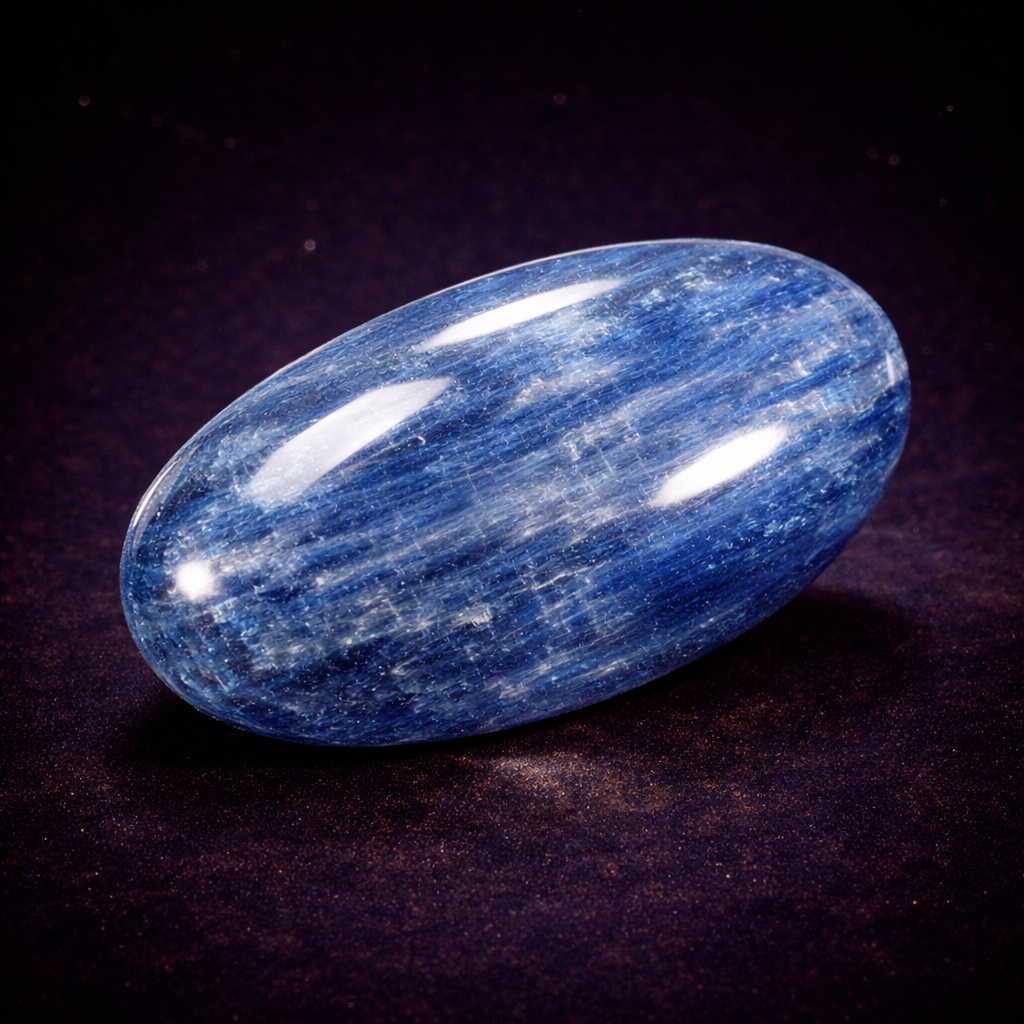
Kyanite is an aluminum silicate mineral with a remarkable property: its hardness varies depending on the direction you test it – 4.5 along its length, 7 across it. This property, called anisotropy, is unusual in minerals. Blue kyanite forms in metamorphic rocks under high pressure. Unlike most crystals, kyanite never accumulates negative energy and never needs cleansing.
Kyanite Meaning & Healing Properties
One of the two minerals that never need cleansing (the other is citrine), kyanite instantly aligns all chakras and subtle bodies. Blue kyanite is particularly powerful for the throat chakra – it enhances telepathy, facilitates communication, and cuts through confusion with clarity. It bridges gaps between people, mends relationships, and promotes compassion.
How to Use Kyanite
- Instant chakra alignment
- Cutting through confusion and illusion
- Telepathy and communication
- Mending broken relationships
- Self-expression and finding your voice
Kyanite Facts
- Kyanite's hardness varies by direction – a property called anisotropy
- It never needs cleansing – one of only two such crystals (with citrine)
- Used industrially in high-temperature ceramics and spark plugs
- Kyanite blades from metamorphic rocks have been found in ancient archaeological sites worldwide
How to Cleanse and Charge Kyanite
Kyanite is unusual: its hardness varies with direction, roughly 4.5 along the length of a blade and up to 7 across it, which means it can be scratched easily one way and resist scratching the other. It also has perfect cleavage and forms thin bladed crystals, so it splinters and flakes if handled roughly or soaked. Rinse briefly at most, never use salt, and store it flat and separately — kyanite blades snapped in a crowded pouch are a common complaint. It is widely held to be self-cleansing, which conveniently removes most of the need to wash it at all.
How to Spot Fake Kyanite
Kyanite is rarely faked outright, but dyed quartzite and dyed howlite are sometimes sold under the name, and blue-dyed material is common at the cheap end. Genuine kyanite forms flat bladed crystals with a distinctly pearly, almost satiny sheen along the cleavage faces and fine striations running lengthwise. The colour is characteristically uneven, often deeper along the centre of a blade and paler at the edges, with white or grey patches. Anything uniformly coloured, rounded rather than bladed, or lacking that lengthwise striation deserves scepticism.
What to Pair Kyanite With
Kyanite is associated with alignment and with clearing blockages, and it is one of the stones most often used alongside others rather than alone — many people pair it with selenite, since both are described as clearing rather than absorbing. With amethyst it leans towards meditation, with sodalite towards communication. Black tourmaline grounds it. Its blades are fragile enough that it should be stored apart from whatever it is paired with.
Questions People Ask About Kyanite
Can kyanite go in water?
Only briefly. It has perfect cleavage and forms thin blades that splinter, and soaking can work into the cleavage planes. Most people skip water entirely, since kyanite is generally considered self-cleansing.
Why does my kyanite scratch so easily?
Because its hardness is directional — around 4.5 along the blade and up to 7 across it. That anisotropy is one of kyanite's identifying characteristics.
Does kyanite need cleansing?
It is widely described as self-cleansing, like selenite, which is why it is often used to clear other stones rather than being cleared itself.
What is kyanite used for?
Traditionally for alignment, clearing blockages and honest communication. It is a common meditation stone and is often laid along the body rather than carried.
Where to get Kyanite
If you want to work with Kyanite as a physical stone, here are three forms commonly used.
As an Amazon Associate, we earn from qualifying purchases.