Origins & Geology
Found in: Russia (Ural Mountains), Australia, Sweden, Brazil
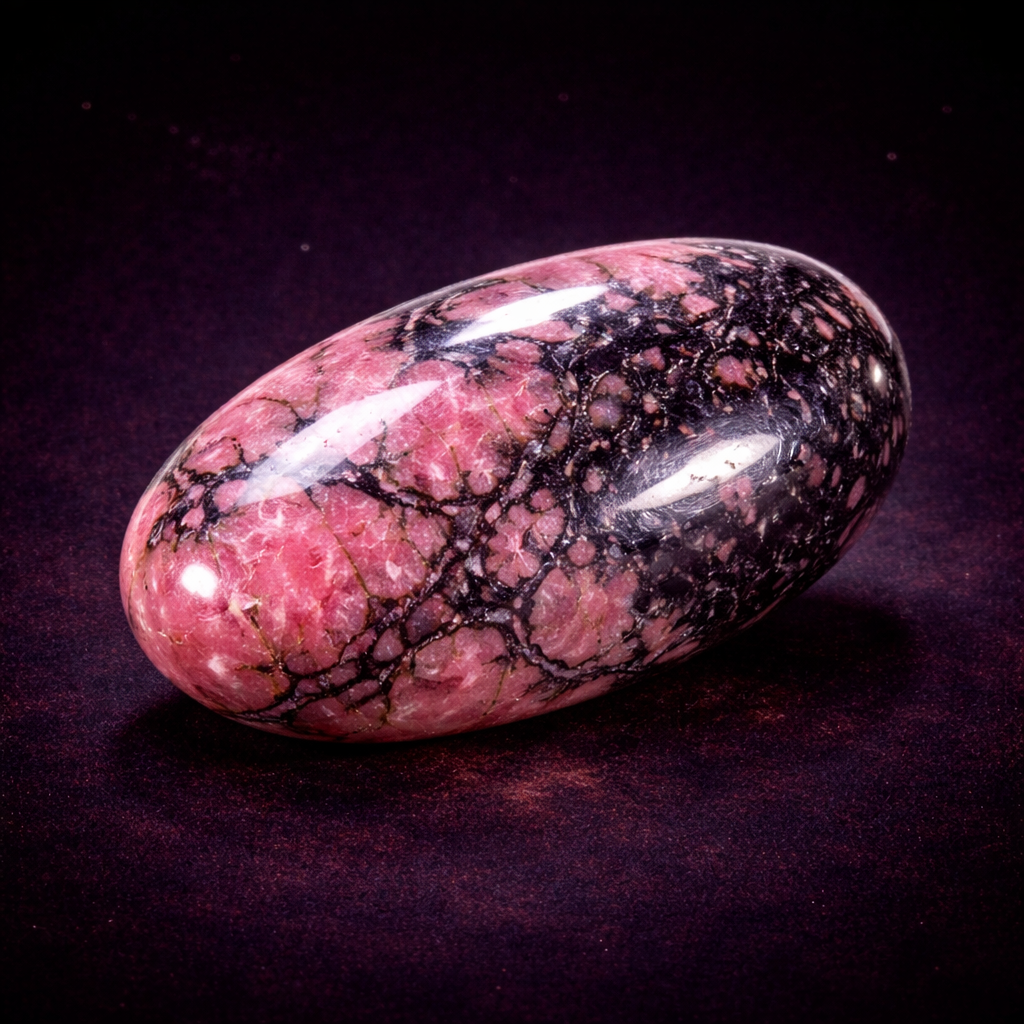
Rhodonite is a manganese inosilicate mineral, typically pink to rose-red with black manganese oxide veining that creates a distinctive marbled appearance. The name comes from the Greek rhodon, meaning 'rose'. The finest specimens come from Russia, where it has been used ornamentally since the 18th century – the Tsar's family used it for decorative objects.
Rhodonite Meaning & Healing Properties
Known as the 'rescue stone' and 'stone of compassion', rhodonite heals emotional wounds, trauma, and self-destructive patterns. Its black veining represents the wounds, and the pink the love that heals them. It is especially powerful for forgiving others, healing past-life wounds, and recovering self-worth after abuse or loss.
How to Use Rhodonite
- Emotional healing after loss or trauma
- Forgiving yourself and others
- Recovering from heartbreak
- Building self-worth and confidence
- Inner child healing work
Rhodonite Facts
- The black veining in rhodonite is manganese oxide – part of the same element that gives it its pink colour
- Russia designated rhodonite as a national stone in the 19th century
- The Tsar's family used rhodonite extensively for decorative objects in the Hermitage
- First aid workers and emergency responders often carry rhodonite as the 'rescue stone'
How to Cleanse and Charge Rhodonite
Rhodonite is a manganese silicate, and manganese is the reason for both its rose colour and its care requirements. The black veining running through most pieces is manganese oxide, and prolonged damp encourages further oxidation, spreading the black at the expense of the pink. Rinse briefly at most, never soak, and dry it thoroughly. Sunlight dulls the colour over time. Some material is porous enough to absorb oils, so keep it away from lotions and perfume, and clean it with a soft dry cloth.
How to Spot Fake Rhodonite
Dyed howlite and dyed magnesite are the common substitutes, along with resin composites moulded to imitate the veining. Genuine rhodonite has irregular black dendritic veins that branch unpredictably and vary in thickness, set in a pink that ranges from pale rose to deep raspberry within the same piece. Fakes show veining that is too even, too uniformly wide, or visibly repeating across multiple beads in a strand. Dyed material will also show colour concentrated in surface cracks and can transfer onto a cotton bud with acetone.
What to Pair Rhodonite With
Rhodonite is a heart stone with a practical edge — it is traditionally used for forgiveness, emotional recovery and the working through of resentment rather than for romance. That makes it a natural partner for rose quartz, which is softer, and for rhodochrosite, which is more inward and childlike in focus. Black tourmaline grounds it when the emotional work gets heavy. Amethyst pairs well for anyone using it in meditation.
Questions People Ask About Rhodonite
Can rhodonite go in water?
Only briefly. It is a manganese silicate and prolonged damp encourages the black manganese oxide veining to spread. Rinse quickly if at all, and dry it fully.
What are the black lines in rhodonite?
Manganese oxide, which forms naturally alongside the pink manganese silicate. The irregular branching pattern is one of the better signs that a piece is genuine rather than dyed.
What is rhodonite used for?
Traditionally for forgiveness, emotional recovery and working through resentment — a more practical, less romantic heart stone than rose quartz.
How is rhodonite different from rhodochrosite?
Rhodonite is harder, usually darker pink and marked with black veining. Rhodochrosite is softer, banded in pink and cream, and associated with self-compassion rather than reconciliation.
Where to get Rhodonite
If you want to work with Rhodonite as a physical stone, here are three forms commonly used.
As an Amazon Associate, we earn from qualifying purchases.