Origins & Geology
Found in: Canada (Labrador), Madagascar, Finland, Russia
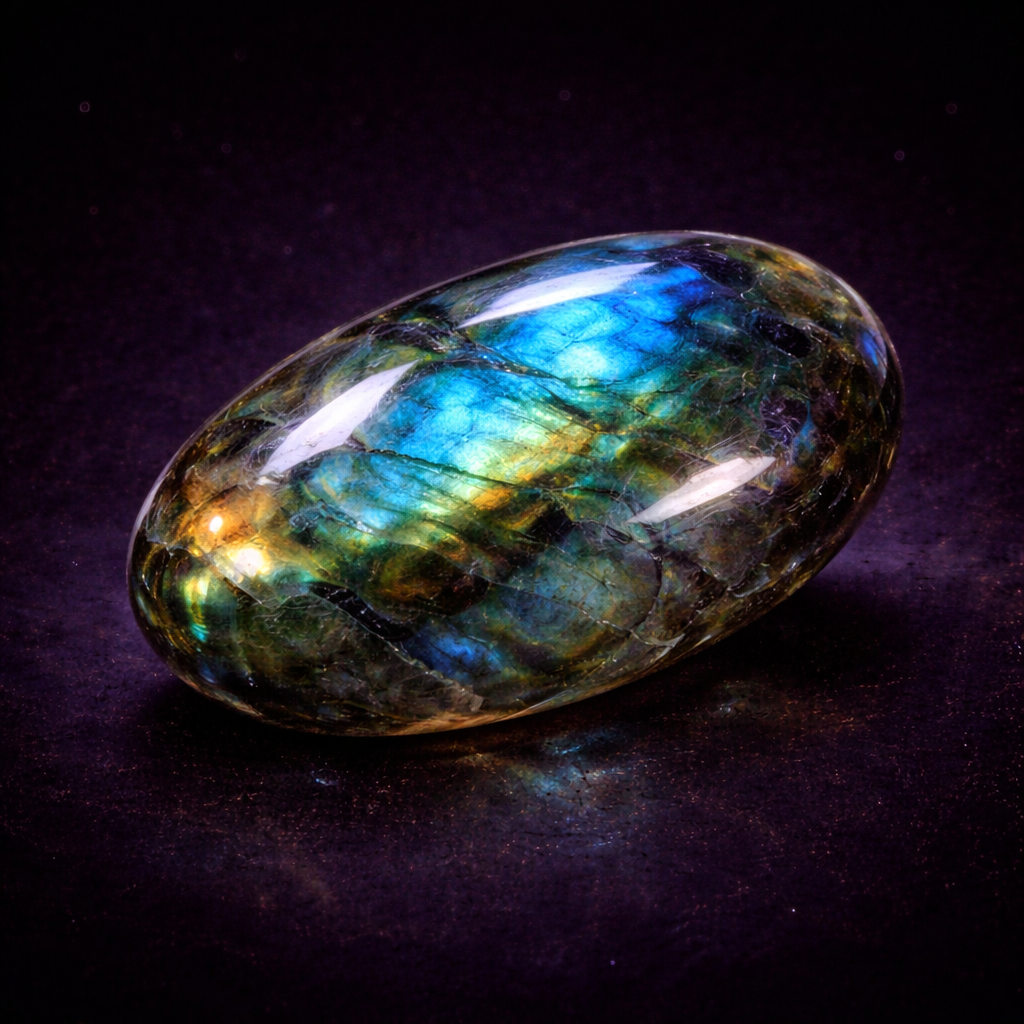
Labradorite is a feldspar mineral famous for labradorescence – a stunning optical phenomenon where the stone flashes brilliant blues, greens, golds, and purples as light hits internal twinning planes. First described from specimens found in Labrador, Canada in 1770. Finnish labradorite showing exceptional play of color is marketed as 'spectrolite'.
Labradorite Meaning & Healing Properties
Called the 'stone of magic' and 'aurora borealis stone', labradorite is the premier crystal for awakening mystical abilities – clairvoyance, telepathy, astral travel, and prophecy. It creates a protective barrier against negative energies while allowing one's own light to shine through. Inuit legend says the Northern Lights were trapped inside labradorite.
How to Use Labradorite
- Developing psychic and intuitive gifts
- Protection during spiritual work
- Astral travel and lucid dreaming
- Awakening magical abilities
- Shielding against energy vampires
Labradorite Facts
- The optical phenomenon is called 'labradorescence'
- Finnish spectrolite shows the full spectrum of the aurora
- Inuit peoples believed labradorite fell from the frozen fire of the Aurora Borealis
- It was first scientifically described in 1770 from specimens found in Labrador, Canada
How to Cleanse and Charge Labradorite
Labradorite is a feldspar with the same cleavage weakness as moonstone, so despite a respectable hardness of 6 to 6.5 it will split cleanly if knocked on the wrong plane. Rinse briefly in cool water rather than soaking, and dry it fully. Salt scratches the polished surface, and it is that polish that produces the flash. Sunlight does no harm. Store it separately from quartz and harder stones, which will scuff it over time in a shared pouch.
How to Spot Fake Labradorite
Genuine labradorite is judged by its labradorescence — the flash of blue, gold or green that appears only when the stone is turned to a particular angle and vanishes at others. Imitations, usually glass with a foil or coated backing, glow from the whole surface at once and keep glowing whatever the angle. Under magnification, real labradorite shows fine parallel striations along the cleavage planes. Assembled doublets exist too: check the edges for a glue line between a thin slice of stone and a backing layer.
What to Pair Labradorite With
Labradorite is the stone of transition, so it is usually paired with something that steadies or something that clarifies. Black tourmaline or obsidian ground it. Moonstone extends it towards intuition and cycles. Amethyst pairs well for anyone using labradorite in meditation rather than as a daily carry. Because it is associated with protecting the aura during change, many people keep it with them alongside a heart stone such as rose quartz during genuinely difficult periods.
Questions People Ask About Labradorite
Can labradorite go in water?
Briefly. It is a feldspar with strong cleavage, so avoid soaking, hot water and salt, all of which can work into the natural splitting planes.
Why does my labradorite only flash sometimes?
That is exactly how it should behave. Labradorescence comes from light bouncing off internal layers, so it appears at particular angles and disappears at others. A stone that glows evenly from every angle is probably glass.
What is labradorite good for?
It is traditionally used for periods of change, for protecting your energy in draining environments, and for intuition and dream work. It has a reputation as a stone for transitions rather than for calm.
Is rainbow moonstone the same as labradorite?
White labradorite is frequently sold as rainbow moonstone. It is a genuine stone, but mineralogically it is labradorite rather than true moonstone.
Where to get Labradorite
If you want to work with Labradorite as a physical stone, here are three forms commonly used.
As an Amazon Associate, we earn from qualifying purchases.