Origins & Geology
Found in: Argentina (Inca Rose), South Africa, USA (Colorado), Romania
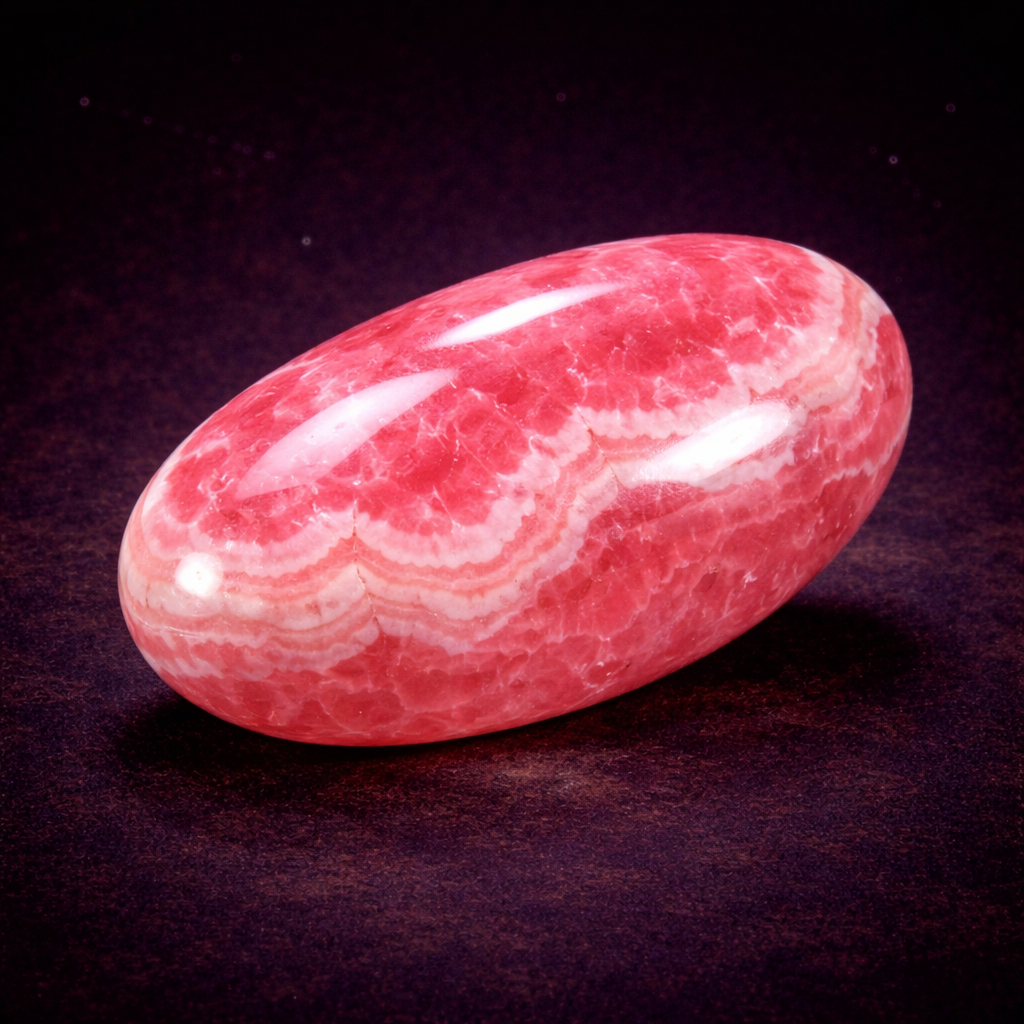
Rhodochrosite is a manganese carbonate mineral with a distinctive rose-pink to cherry-red banding. The finest specimens come from Argentina's Catamarca Province – the Incas believed the stone was the solidified blood of their ancient kings, giving it the name 'Rosa del Inca' or 'Inca Rose'. It forms in hydrothermal ore veins alongside silver, lead, and copper.
Rhodochrosite Meaning & Healing Properties
The ultimate stone for healing the inner child and inviting deep self-love, rhodochrosite works on wounds formed in early life – particularly those involving abandonment, rejection, or emotional neglect. It gently brings painful memories to the surface for healing rather than suppression. Known as the stone of the compassionate heart, it teaches one that suffering can be a gateway to joy.
How to Use Rhodochrosite
- Inner child healing
- Self-love and self-worth
- Healing abandonment wounds
- Recovering from deep emotional trauma
- Opening the heart to joy after grief
Rhodochrosite Facts
- The Incas called it 'Rosa del Inca' – believing it was the solidified blood of their ancestors
- The world's finest rhodochrosite comes from the Capillitas mine in Argentina
- It is Colorado's state gemstone
- The 'Alma King' – a 4-inch rhodochrosite rhombohedron found in Colorado – is one of the world's most perfect crystals
How to Cleanse and Charge Rhodochrosite
Rhodochrosite is a manganese carbonate, soft at 3.5 to 4, and carbonates react with acids and dissolve slowly in water — which rules out rinsing, soaking and salt entirely. Even humid air will gradually dull a polished surface. Sunlight fades the rose pink towards brown. Clean it with a dry soft cloth only, store it away from harder stones since it scratches very easily, and charge it with moonlight or sound. Banded material with cream stripes is the most fragile, as the bands can separate along their boundaries.
How to Spot Fake Rhodochrosite
Reconstituted rhodochrosite — powder bound in resin — is common and often sold at prices that suggest solid stone. Genuine rhodochrosite shows irregular concentric or wavy banding in rose pink, cream and white, with bands of varying thickness that never repeat exactly and often form imperfect circular eyes on a cut face. Composites show banding that is too regular or that fails to continue logically around the edge of a bead. Dyed howlite is also sold under the name and lacks banding altogether, showing instead the grey web typical of howlite.
What to Pair Rhodochrosite With
Rhodochrosite is the most inward of the pink stones, associated with self-compassion and with early or childhood wounds rather than with relationships. It pairs naturally with rose quartz, which is gentler and broader, and with rhodonite, which turns the same territory outward towards forgiveness of others. Amethyst supports it in meditation. Because it is so soft, it is nearly always kept somewhere protected rather than carried.
Questions People Ask About Rhodochrosite
Can rhodochrosite go in water?
No. It is a soft manganese carbonate that reacts with acids and dissolves slowly in water. Wipe it with a dry cloth and keep it out of humid rooms.
Why is my rhodochrosite dull?
Usually moisture or handling. It is soft enough to scratch with a knife blade and its polish degrades in damp air, so it needs to be stored dry and separately.
How is rhodochrosite different from rhodonite?
Rhodochrosite is softer, banded in pink and cream, and used for self-compassion. Rhodonite is harder, darker and veined with black manganese oxide, and is associated with forgiving others.
What is rhodochrosite used for?
Traditionally for self-compassion and inner-child work — healing directed inward rather than towards a relationship.
Where to get Rhodochrosite
If you want to work with Rhodochrosite as a physical stone, here are three forms commonly used.
As an Amazon Associate, we earn from qualifying purchases.